Voices: Our Scars

In the second of our ‘Voices’ we are delighted to introduce you to Miranda. Miranda writes prose and poetry that is born out of her personal life experiences and her observations through practice with others. She illuminates places and events from the inside-out.

Our Scars

They didn’t mean to do it. Not really.

Characters larger than life who just didn’t belong in a row of terraced housing in Leeds. My mum liked to waft around in her kaftan, gin and tonic in hand. My dad had a red face and a loud laugh and always sat at the head of the table and held court.

In the early days the house was always full. Parties every night, everyone bursting at the seams. My dad’s voice could be heard right down at number 32 at the bottom of the hill. Reckless hilarity playing out often until 6am. It was hard for my brother and me as we had to be up for school. After no sleep we would climb over the bodies on the stairs and into the kitchen carnage to make some breakfast. Often to find there was no food. Always an array of empty bottles on the counters and the floors. Once my brother sliced his foot open on some broken glass. We had to call Mrs Zimmer next door who took him to the hospital. We couldn’t wake mum and dad.

Those were the fun times. Dad was changeable like the weather. On his sunny days he would grab us as we ran past and pull us onto his knee. Tickle us until we couldn’t breathe. Smother us with whisky kisses. Slap us affectionately around the head until we saw bright lights and sharp pains. Then tell us to piss off. Sometimes he came home (from his mysterious ‘work’) with bulging bags of boiled sweets. Or a crisp 10 pound note each. Other times he came home with a rough beard and dark circles under his eyes. Then he would just go to sleep. Mum would mutter under her breath something about whores. We never really knew where we were with dad. I guess that made it more exciting. I know my brother was really scared of him.

We knew that he hit mum. Sometimes she would have a black eye or a bruise on her cheek. She would try to hide it with make up or sunglasses. She would say that she had walked into the door. To some people my mum may have seemed invisible. She was fragile like china. To us she was like an ethereal fairy queen. Pale and beautiful. Bewitching and detached. To be admired from a distance. She tried to be a warrior in the end. Rising up to triumph in the face of adversity. Not easy after two bottles of Vodka.

My brother and I had to lie to our teacher. She often asked if we had eaten breakfast. Once she asked us if our washing machine had broken. Another time she gave me some shiny shoes and said that her daughter had grown out of them. Looking back I think she was worried about us. Life wasn’t perfect but we muddled through.

Until that day. The day everything changed.

Mum and dad had been to the pub. Their days of wild parties had diminished. Dad looked worn now like an old overcoat. He hung in loose folds. Mum was lined and her face was hard. She didn’t speak very often. Well not to us anyway. Her shine had gone. We always tried to hide when they came back from the pub. We would stay in the shadows while my dad’s face grew redder and we knew what was coming. Mum would stand and wait for the punch. He would usually miss. After nine pints of lager and four whisky chasers he was a poor aim.

We watched as she threw something over dad. It all happened in slow motion like a bad film. I ran in and tried to push her over as she lit the match. Dad would have gone up in flames but my brother pulled him out of the back door and he landed on the rosemary bush. I wasn’t quite so fortunate. I didn’t actually ignite. Just smouldered a bit. I remember the pain. I remember the screams. Mrs Zimmer’s face leaning over me with her mouth open. I must have looked bad. Fade out.

I was in hospital for several weeks I think. It was all a bit of a blur. My brother came every day. He cried a lot and said that we had a new home. Mr and Mrs Blake. He said they always made breakfast. Mum and dad had disappeared. He wasn’t sure where they were. No one was really telling him anything. He had heard Mrs Blake and the social worker talking about a court case. I don’t think he really wanted to know.

That was my brother all over. He left number 91 Rigby Terrace that day with emotional scars. I left with a melted cheekbone and singed eyelashes.

If the content of this article has led you to think you need support or someone to talk to then the organisations listed below at the links provided can offer such services. Please do contact one of these organisations if you feel you need help

Samaritans – Mental Health At Work

https://www.samaritans.org/

https://www.womensaid.org.uk/domestic-abuse-directory/

Home | Refuge Domestic Abuse Helpline

https://www.nationaldahelpline.org.uk/

https://www.mensaid.co.uk/

DesignStudio rebrands Mind with focus on social change | Design Week

https://www.mind.org.uk/

Voices: It’s a struggle being poor

In the first ‘Voices’ that Social Work Shorts would like to bring you this is a testimony from a 38-year-old single mum living in the South of England and is taken from the insightful collection of illuminating and much needed writing in a book created by Dominic Watters (Twitter @SingleDadSW).

You can find the book at this link. 

It’s a struggle being poor

I’m a Dutch national of African descent and single mother of two boys. I have been living and working in the United Kingdom for the past 15 years. I was in a tumultuous relationship for nine years which resulted in my children and myself being made homeless. We were initially placed in a hostel for eight weeks in another borough before my local council rehoused us into a temporary one bed council complex, where we were placed with families who faced similar circumstances that I’ve been experiencing. After three years, I’m currently still waiting to be housed into my permanent place.

I’ve worked at Gatwick Airport for the past 15 years and was made redundant due to the impact Covid had on the airport. During lockdown, not only did I lose my job, my electricity and shopping expenses increased due to the kids being stuck indoors. Prior to when the government finally decided to introduce school meal provisions and the £20 Universal Credit top-up, I succumbed to using my credit card to provide for our basic needs. At times, I had to reach out to the local church for help with food and supplies.

Going through all this, I was also faced with the task of home-schooling my children in an overcrowded space and unable to engage in social activities which has been very challenging. This negative impact has definitely tested my boy’s mental health.

As if this hasn’t been stressful enough, I also endured racist abuse from my new next door neighbour’s boyfriend (they moved in during Covid) who referred to me as the N-word after a violent outburst in the middle of the night. I was both angry and scared for my children and I felt trapped in my own space. I reported this and he has been spoken to by the police. Although I hope this won’t happen again, he’s still there.

It is a real struggle having a narcissistic ex-partner who doesn’t pay child maintenance, myself not being financially secure. Living in half-way housing and trying to keep my sons unaffected has proved to be very testing for my own sanity at times but I’m pleased to say that I have found a new job as a teaching assistant at my boy’s primary school.

Snippet taken from the Social Distance in Social Work: COVID Capsule One

About Social Distance in Social Work: COVID Capsule One

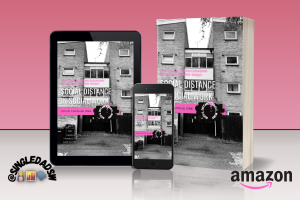
A social work student facing eviction from his home and experiencing food insecurity authored this book in the hope that it could get his voice heard. As a single dad living in a council estate block of flats, Dominic @SingleDadSW lets the reader into an environment drenched in poverty. He invites some of the leading thinkers, practitioners, and people with lived experience of services to discuss the impact of the COVID crisis.

The COVID crisis made everyone aware of keeping their distance from other people because of health concerns, but SingleDadSW was reflecting on the distance between people due to poverty, culture, class, and other factors. Social Distance in Social Work: COVID Capsule One is both an action in the face of destitution, and a collection of notes from the crisis. A collection of pieces that he has curated to tell a story and capture a moment in time.

A book that discusses established and new approaches in Social Work:

  • • Social Justice & Social Distance
  • • Food Poverty & Food Insecurity
  • • Lived Experience & Living Experience
  • • Child Protection & Social Harms
  • • COVID Crisis & Crisis Capitalism
  • • Social Work During the Pandemic

Featuring all exclusive work by Ray Jones, Phil Watson, Brid Featherstone, Cal Webb, Gerry Nosowska, Simon Haworth, Lewis Roberts, Ian Gould and more… and includes a foreword by Ruth Allen, chief executive of BASW.

Book Endorsements

‘A stunning book right from the heart of exciting, newly emerging social work practitioners. At its core is a genuine commitment to the application of rights-based practice made possible by the authors personal, deep understanding of social justice and the impact of structural oppression of poverty.’

Rob Mitchell, principal social worker, co-author of ‘Social Work, Cats & Rocket Science

‘We are a human rights profession. But it can be hard to embed this into everyday practice. This book is a precious and creative contribution to understanding how we can do that.’

Ruth Allen, chief executive of the British Association of Social Work (BASW)