Myron’s Maxims – this weeks discovery

I came across this concept last week – Myron’s Maxims – and thought I’d have a delve into it and do some thinking!

Myron Rogers is an expert in organisational development and systems thinking, known for his work in helping organisations manage change and complexity. He is particularly recognised for his application of systems theory to organisational leadership and change processes. He explores  the importance of understanding organisations as complex systems and looks at how change emerges from the interactions and relationships within systems.

He is best known for articulating Myron’s Maxims, a set of principles that guide organisational change and leadership but also tell us a lot about life – and for this article – social work! Here they are….

– People own what they help create

– Real change happens in real work

– Those who do the work, do the change

– Connect the system to more of itself

– Start anywhere, follow everywhere

– The process you use to get to the future is the future you get.

Let’s look at them….

People own what they help create

Here he emphasises the importance of participation and co-creation in achieving lasting change. This resonates for me in life and social work practice. We know co-creation of strategies for change or care planning lead to better outcomes for people and they engage better with self-created options. And we know that in life in general we do better when we do things with other people – or at least doing things with other people is an important component of our well-being. The other being time on our own!?

Real change happens in real work

This suggests that transformation comes from actual, hands-on practice, not from abstract plans. Christine, my wife, is always saying to me, ‘ok then – just do it!’. And she’s right I often procrastinate in the thinking stage. There comes a point where you have done enough thinking and know enough so you then must do something. That’s where the real change takes place. Eileen Munro made this same point in her review of children’s services – you need to figure out when you know enough and then actually do something. I’m not saying that’s easy, but it is essential.

Those who do the work, do the change

This reinforces the idea that people directly involved in the work are best positioned to create meaningful change. We can’t have someone else go to the gym for us. We must go. We can’t do the work for people we are working with. They must do the work. That’s the only way to make true change happen.

Connect the system to more of itself

You need to be focusing on leveraging existing networks and relationships within a system to foster change. The idea is that systems (whether an organisation, community, or even an individual’s life) are made up of interconnected elements. When you strengthen these connections, you enable better communication, collaboration, and shared understanding, which ultimately leads to more sustainable and effective outcomes. In social work, consider a case where a client is facing homelessness, unemployment, and mental health challenges. Instead of addressing each issue in isolation, the social worker connects the client to a network of services—housing support, employment counselling, mental health services, and peer support groups. By linking these different services (parts of the system) and encouraging them to collaborate, the client receives more comprehensive support. This holistic approach, which “connects the system to more of itself,” ensures that the various agencies don’t work in silos but come together to address the client’s needs in a coordinated and integrated manner, leading to better outcomes.

Start anywhere, follow everywhere

This maxim encourages a flexible approach to change, allowing it to emerge from any point within the system. Making a starts the hardest part I’m fond of saying but simply doing something creates momentum and motivation. And then follow where the momentum takes you. Consider a case where a family is referred to a social worker due to concerns about a child’s behaviour at school. The referral might initially focus on helping the child with behavioural interventions. However, as the social worker engages with the family, they might uncover other underlying issues—such as financial stress, parental conflict, or untreated mental health challenges in one of the parents. Rather than rigidly sticking to the initial issue (the child’s behaviour), the social worker “follows everywhere” by addressing the broader context, helping the family with financial resources, referring parents to counselling, and working with school staff to support the child holistically.

The process you use to get to the future is the future you get

This highlights the importance of the methods and processes used in shaping the desired outcome. You fall to the level of your systems rather than rise to the level of your goals. Systems, planning, and routine are everything. What you look for you see. Be careful what you look for and always have a system or plan.

Myron’s Maxims and Living a Good Life

Myron’s Maxims emphasise the importance of ownership, process, and interconnectedness, all of which are key to living a fulfilled and meaningful life. The principles acknowledging that people own what they help create and that real change happens in real work. They highlight the value of personal involvement in shaping your own path. A good life is not just about outcomes but also about the processes we engage in daily—the relationships we build, the systems we connect with, and the ways we contribute. The idea that the process you use to get to the future is the future you get underscores that living intentionally, fostering positive connections, and remaining flexible in adapting to life’s challenges are essential for achieving long-term satisfaction and purpose.

Myron’s Maxims in Social Work Practice

In social work, Myron’s Maxims align perfectly with empowering individuals and communities. People own what they help create speaks directly to participatory practice in social work, where service users are active partners in decision-making, helping them take ownership of their lives and outcomes. Real change happens in real work resonates with the importance of practical, hands-on interventions and ongoing reflection. The maxim those who do the work, do the change highlights that transformation in clients’ lives occurs when they are deeply involved in the process, rather than simply being passive recipients of support. Finally, connecting the system to more of itself and starting anywhere, following everywhere encourage social workers to view their interventions holistically, understanding the client as part of a wider system and recognising that change can begin from any point in a client’s journey. Ethical, collaborative, and systemic. Thanks Myron!

Working from home: Are you a segmentor or an integrator? It could make a difference.

When it comes to thinking about working from home the psychology literature would suggest there are broadly two types of people.

Some of us are Segmentors. We prefer to keep work and non-work separate so may struggle with them being in the same place. Segmentors may find it difficult to strike a balance. Sometimes this is to do with work role. So, some of these things are job as well as person specific. Some jobs have weak role boundaries while some maybe can offer more flexibility. Maybe there is significant overlap between personal interests and professional ones. Possibly the job allows for a great deal of autonomous work. These things may make it difficult for some to keep things separate when working and living in the same space. Some jobs have strict role boundaries so may be easier to segment even at home especially if you are a segmentor.

Some people are Integrators. Such people prefer (or are happy to) integrate work and non-work. Alternatively, where a job has weak role boundaries it may be inevitable that the two merge. Integrators might therefore struggle at home with a job that has strong role boundaries and maybe such jobs are less suitable for home working.

My job as an example.
For most of my working days each week I work for a university. This job drifts between days when role boundaries are weak. For example, I may have the opportunity to read a lot, and I often read for pleasure the sort of books I need to read for my job. There is no boundary between the two. I browse the web, take notes, connect ideas, and spend time thinking. I do this for work, and I do this for myself for pleasure. On days like these it can be difficult to see whether a particular activity is work related or not. Some days though I need to deliver lectures and seminars. There are strong role boundaries on those days, and even when I was delivering things from home during the pandemic, I had to be in a certain place at a certain time to do a certain thing with little flexibility. I work freelance some of the week and on those days it’s often difficult across a whole day to see any delineation. I’m definitely a natural integrator which is probably why I love home working but I’m happy to be a segmentor when the tasks of the day require it.

Our well-being when it comes to our whole lives is an interaction between person – role – and environment.

What sort of person are you?
What sort of roles do you have at work and outside of works?
What is the environment like you have to operate in? Does it help or hinder?

Are you a segmentor or an integrator?

Churning the Soil, caring professions (health, teaching and social care) and Madonna.

agraph

Last month I enjoyed the lecture of Durham University’s new social work lead Professor Carlene Firmin, on contextual safeguarding. I was particularly energized by the language of “spaces” and shifting the risk assessment paradigm from a myopic focus on families to variously friendship groups, streets and parks, or entire school years, and as investigative social workers exploring these rich untapped veins for solutions and real dangers for children.

Whilst energized however a second thought came over me like a groaning wave, (one familiar to all key workers) – PLEASE NOT ANOTHER…. new idea, review, reinvention, piece of legislation, policy, procedure, theory, research says, academic says, think tanks says, the news says, Daily Mail headline, in country X they, in local authority Y they, new computer system, new head of service, serious case review, act of parliament, DFE says………………………………..

Children’s social care is currently going through a major review, led amazingly by a non-social worker (Josh McAlister) whose current agenda has been developed variously through rehashing either ideas he had ten years ago, or elite teacher training models, whilst staring through a pair of Tory blue Etonian binoculars. Like many confidence tricks however the solution or outcome must be seen to be the idea of the “mark”, the “mark’ being the victim of the con. Josh has achieved this through the cynical way he has used people with lived experience from care experience in a similar way that McDonalds uses salad and its grassroots football sponsorship to promote itself as part of a healthy diet.

Josh and the Conservatives will seek to implement this review and once again our profession will be asked to march unquestioningly in a new direction.

However, is there any energy or resources left in our professions to turn from caterpillar to butterfly or do a Madonna (Like a Prayer-Dick Tracy-Frozen). Do we need to stand still and reflect, or must we lunge forward, must we radically change over and over and over? And in doing so what is the impact?

Whilst this link to relentless change in social work or other caring professions may seem loose, perhaps this strangely prescient quote from the material girl makes the case;

“49% of the time I was crying, usually from over-exhaustion. But there’s something about pushing yourself out there when it’s pouring rain or you’re freezing cold or you don’t feel well or something really crazy happened in the world like Hurricane Sandy.”

As teachers, carers and social workers we can’t solider for long or we slowly surrender our essence, our life force (I’m using the word ‘soldier’ here both in the army sense and the scientific management sense of Talyorism). There is a cruel juxtaposition of being drained, burnt out and chewed up while doing the job (the human part) we adore and helping people we are committed to and love working with. Every few months, or for bigger changes each few years, we are meant to leap on board an entirely new way of teaching, or safeguarding or treating, because someone sat well away from the classroom, frontline or ward says we should.

Each time we change direction and re focus we are giving up even more of our already depleted resources (however well-intentioned the changes are)

We are collectively the soil of our professions. (Nothing will grow without us)

  • Time for some amazing Soil facts.
  • It is essential for 95% of our food
  • It stores ten times more carbon than the worlds trees
  • It’s a living complex and sophisticated system passing nutrients
  • Darwin heralded the earth worm as the most important creature on earth.
  • It takes thousands of years to make an inch of new soil

How do we treat this most vital resource and what’s the link to our professions?

  • We over work the soil (overcropping) – (High caseloads, large classrooms, workload)
  • We spray chemicals (privatization, outsiders coming in to tell us how to do it better. Soil does not need much more than not to be harmed)
  • Man made floods rip it from the land, (Regular external threats tip the balance further against us – COVID, Austerity)
  • Two thirds of the worlds soil is lost. (High turnover rate in the caring professions, most don’t last more than 5 years with one third quitting (this example from teaching))
  • Global vampire capitalists own vast sways of farmland firms like Monsanto or McDonalds (Care Tech, Credit Suisse, KPMG all involved in the review and the ££care££sector££)

History tells us that the decline of the Roman, Aztec and Mesopotamian (fertile crescent) empires can be put down to exhausting soils nutrients through war and over and mono cropping. I feel the caring professions are in a similar set of dire straits. The main culprits who deplete our professions soil being OFSTED, the government, and the media.

Endless Change = Endless Depletion

As we are cajoled and pressured by the likes of OFSTED or the care review, our resources are drained and the quality of the soil is derogated, simply ask too much too often of soil and the crops will start to fail and fail permanently.

However how do we survive this agricultural abuse as practitioners because many of us strive to do so?

I would suggest there are 4 main damaging positions we occupy in the caring professions

These positions are extremes but many of you will have seen countless examples of them partly or fully formed in colleagues across the years. They are understandable hiding places we seek to occupy as we are repeatedly damaged by external factors in our professions.

My warning is that unless our professions resources are seen as a key part of any review or change from government inevitably it will just be another act of strip farming with our capacity depleted further and further.

To get the most out of the Soil we must allow the farmers who work and care for the land to be in charge. Left alone they will prosper. Interference from those far from the field who seek profit and success over partnership with the land will be ultimately catastrophic.

About the writer…..

Bull

George has been a social worker for 10 years working mainly in child protection and Early Help. He has lectured with Jamie Scorer at New College Durham, University of Sunderland and University of Northumbria in solution focused practice.

The transition problem – student to practitioner

In their book ‘The Lost Art of Running’ Shane Benzie and Tim Major talk about research that was undertaken with athletes that sought to explore their running gait and style. The research was conducted indoors on a treadmill so that the researchers could control conditions. They watched the athletes and learnt lots about how they ran and offered suggestions to improve. They runners got better at running.

They then moved outdoors and…. the improvements disappeared. The changes didn’t work the same. Because outdoors – real life if you like – isn’t the same as in the lab. The runners still used what they had learnt but had to re-engineer and, in some cases, relearn some of what they knew. Social Work is the same. What you learn at University and what you learn on placement gets you through the door and you then need to transfer that knowledge into the real world of practice.

Croisdale-Appleby noted this in the 2014 report Re-visioning Social Work Education and said ‘the first year of practice is absolutely vital for social workers as they consolidate the learning from their degree and develop new knowledge and skills in their first employment setting’

Playing the guitar

Let me give you another example. I’m a guitarist and have taught many people over the years to play the basics. If I was to hand someone a guitar they would intuitively know what to do with it…. to a point. They would know not to try and blow into it like it was a wood instrument. They would know it wasn’t something to help them with cooking. They would probably pluck the strings. I’d then teach them a little theory. Which string needs to be tuned to which note and what shapes to place your fingers in on the fret board to make chords to strum. We’d then practice. We’d replay, over and over again, the same shapes and learn to change between them. Over time we’d learn to play a song with the chords we had learnt and invariably the student says I’d like to play ‘song x’. So you look at ‘song x’ and realise that the guitar student knows most of the chords but needs the chord of F to play it all. F is not an easy chord for a beginner. They feel like they are back to square one and their confidence takes a knock. But over time (a long time) they overcome this, learn F, and a whole other set of chords, and they become proficient enough to play with other people and maybe join a band. They have to learn to then play in time with others… this is not as easy at it sounds. Then… someone might ask them to improvise a guitar solo which they’ve never done before so they use their intuition! ….based on the theory they know and the practice they have done Full circle! And the first time they do it it may well be alright but it might not be brilliant but they’ll practice and it will get better

Intuition > Theory > Practice > Time > Intuition (or as we call it Practice Wisdom)

Starting in practice

Evidence from Grant Sheridan and Webb (2017) suggests that newly qualified social workers felt ‘quite well’ or ‘very well prepared’ for practice in general. However, when this is broken down into preparedness for specific tasks, confidence levels drop. Essentially I’d suggest this is because specific tasks are often context specific (the type of social work you are doing and the organisation you are doing it in) and role specific – that is – not generic. You have to reapply the skills from the treadmill on the outdoor running track.

The conclusion of formal social work education is only one layer of the learning experience which is continuous throughout your career (or should be).

They also found that respondents felt most prepared to ‘promote and enable’ (89 per cent) and least prepared to ‘intervene and provide’ (32 per cent). Again because intervene and provide is context specific whereas promote and enable has a more value base feel about it. Respondents in the study reported feeling ready to conduct assessments, build relationships and communicate but less prepared for commissioning services and dealing with IT systems. Well they would because you can’t teach this as it is too organisation specific. They said they felt prepared for applying theory and demonstrating values but not for caseload management. It’s not the face to face work that seems to cause the stress but the ‘office’ function the research tells us.

The Dunning-Kruger effect

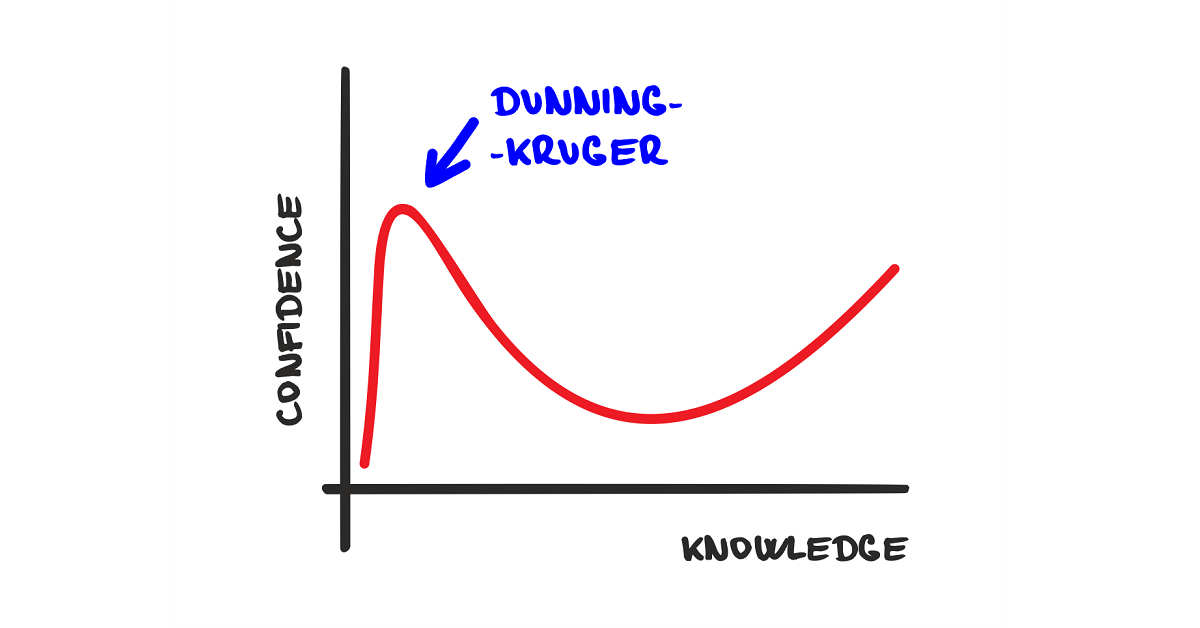
There is also something else going on that relates to the Dunning-Kruger effect. There are certain points in our lives where we are likely to overestimate our abilities and feel quite confident. Usually when we have achieved something that has taken great effort. Like completing a degree or securing a promotion or becoming a manger… or becoming a lecturer! The problem occurs when you transition from something where you are at the top of your game and you have to translate that knowledge into something else. This transition tends to undermine your confidence and you feel like an imposter.

Objectivity's Blind-Spot: The Dunning-Kruger Effect | Procrastination.com

Moving from being a student into practice is one such transition. You’ve just graduated and you know loads of stuff. You’ve just had a great placement and a got a good mark for your dissertation and then you have to translate the knowledge you have (which is valuable) into the new practice environment. You are likely to feel immediately out of your depth and like you know nothing and your confidence will take a hit.

At this point you need to remember some things. This feeling is completely normal for us all, to one degree or another, when we transition. You do know loads of stuff you just need to rework that knowledge into a new environment – stay calm. When transitioning it’s essential to stay focussed and organised. You are going to have to ‘lean into’ this for a while and it will take pretty much all of your energy. As in the diagram above your confidence will take a hit but apply the theory, engage in practice, take your time, and you will develop the practice wisdom to climb up that curve again….. and next time you transition you are likely to have to go through the same process again! Joy!

Remember your degree can not completely prepare you. It can only give you what you need to get started. It gets you the key to the door. Like people say about driving a car. You only really learn to drive a car after you’ve passed your driving test. This is the same. You are qualified, you are good enough, you can do this… but… the transition is going to be difficult and now you know that you can prepare for it.

  • Have growth mindset, a positive attitude, and that will help.
  • Keep on top of your planning and organisation and take time out for yourself.
  • Don’t lose yourself in the transition.
  • Work with your manager and mentor in an honest way and seek out support.

Whenever things are changing those who create as much order as possible do the best.

References:

Newly Qualified Social Workers’ Readiness for Practice in Scotland Scott Grant, Lynn Sheridan and Stephen A. Webb British Journal of Social Work (2017) 47, 487–506

Croisdale-Appleby, D. (2014) Re-Visioning Social Work Education: An Independent Review, London, Department of Health

Empathy, Sympathy and Compassion

“Empathy Is Walking A Mile In Somebody Else’s Moccasins. Sympathy Is Being Sorry Their Feet Hurt”. (Rebecca O’Donnell)

The nature of our work as social workers, (or any caring profession for that matter) is dealing with some marginalised sections of society. We do our job because we care. By the very nature of ‘us’ caring, are we being empathic, sympathetic or compassionate? Let’s take a closer look at and see what the difference is.

Empathy
Often without realising, we empathise with others in our role as social workers on a daily basis. Meaning we try to understand what our clients or their families are going through from their perspective. We often mentally and emotionally place ourselves in their position as a means of really understanding what things must be like for them. This is empathy.

According to Psychologists there are 3 types of empathy;

  • Cognitive empathy; the ability to understand someone else’s thoughts, feelings and emotions from a rationale viewpoint rather than an emotional viewpoint.
  • Emotional empathy; is otherwise referred to as emotional contagion, meaning you ‘catch’ someone else’s feelings, you literally feel what they are feeling.
  • Compassionate empathy; being able to understand how someone else is feeling and take appropriate action in order to help them.

Sympathy
According to Tear and Michalska, (2010), when we perceive, understand and react to the distress or need of another person, this is referred to as sympathy.

The word itself is said to have its origins in Greek ‘Syn’ meaning together and ‘Pathos’ meaning fellow feeling.

Spatial proximital sympathy refers to the level of sympathy we may feel towards someone or something that is geographically closer to us.

Likewise, sympathy for those who we feel are similar to us is called social proximity.

When we become exposed to repetitive situations that trigger our sympathy, we can become less sympathetic and this is what we refer to as compassion fatigue.

Compassion
The word compassion stems from ‘Compati’ latin for ‘suffer with’. When we feel compassion, we are moved by the experiences of others so much that we want to take action as a means of assisting or preventing harm. A classic example is making a financial donation to a charity following a natural disaster such as an earthquake.

Compassion is noted as being a virtue, a moral quality that helps underpin how we view the world around us and respond to those within it.

As we mentioned before if we have too much exposure to pain and suffering we can become removed from the emotion of what others are going through.

How does Compassion fatigue affect us as professionals?

Compassion fatigue according to Figley, (2002) was a term first used by Carla Johnson in 1992 when referring to the repeated exposure of trauma by nurses in emergency situations. Figley explains those of us who have a greater ability to empathise with others are more likely to experience secondary trauma. The Professional Quality of Life Scale suggests burnout and secondary traumatic stress are closely linked to compassion fatigue.

Compassion fatigue is a medically recognised condition these days and I can certainly recognise myself as experiencing this in the months leading to my ‘crash and burn’ and career break. I found myself literally feeling ‘nothing’ whilst clients and their families would be sat breaking their hearts in the midst of whatever crisis they were going through.

Reflection
Prior to my career break, when I had what I now recognise as compassion fatigue, I often wonder whether not ‘caring’ for the people, actually made me a more effective social work practitioner in a pragmatic sense.

During my cold-hearted days, (I know I’m being hard on myself, but hey I’m reflecting!), as a social worker in adult care, not being emotional enabled me to take a step back from those long standing family disputes. You know the ones where one family member accuses another of something he or she said or did (or didn’t do but should have) 20-30 years ago.

Some families try to involve professionals within their family disputes as a means of having professionals ‘on their side’. I wonder whether being less emotional made me more objective and thereby more able to rationalise information I was gathering, thus placing the service user slap bang in the centre of the assessment process as well as enabling me to stand back from any possible hidden motivations of family.

But what about those of us who are not very empathic? Can we learn to become empathic?

Can We Learn To Be Empathatic?
Yes, according to Roman Krznaric, (2015) in his book, Empathy: Why It Matters, and How to Get It. Krznaric, (2010) expands upon five easy steps to expand your empathy;

  • Cultivate A Curiosity About Strangers, talk to them about their lives, interests and views of the world around them.
  • Learn From Your Experiences; reflect upon your own experiences of needing empathy directed towards you from someone else and when this did or did not occur. How did it feel? Explore through reflection times when you failed to empathise with someone.
  • Tackle Your Family Empathy Deficit; sometimes our families are the very ones who fail to be empathic to our needs. Try and put yourself in their shoes and view the world from their perspective.
  • Take An Imaginative Journey, we know our thoughts can influence our feelings, so in taking ourselves on a mental journey, we develop that part of our imagination whereby we can ‘see’ places in our minds eye. Imagine what someone else is thinking or feeling.
  • Challenge Your Prejudices; we sometimes make sweeping judgements about groups of people without even realising we are doing so. Notice yourself doing this and stop. Take a step back and take a long pause reflecting upon what someone’s life may be like. What is life like for someone with chronic back pain? What is life like for someone who has mental health issues?

Theory Of Inner Imitation
When it comes to social work it is actually suggested that many of us come into the profession having had difficult life experiences. So, in essence we may already be de-sensitised to the trauma of others we end up trying to help (Collins, 2014). With the exception of a few studies over the years that showed males are more empathic than women, Kristen Zaleski et al, (2016) explains women are usually more empathic than men.

Whilst there will no doubt be various reasons for this, which I am not exploring here, Riess, (2010) explores the theory of inner imitation. Riess, (2010) drawing upon the work of Carr et al, (2003) explains how neural relay mechanisms allows those of us who are empathic to unconsciously mimicy postures, mannerisms, and facial expressions of others, (Ibid).

Carr et al, (2003) claims in doing so, the same part of our brains that stimulate motor and sensory areas are activated. An example used by Avenanti et al (2005) is when a patient who has their hand muscle pricked by a needle. The person who is administering, (i.e. the nurse) will also ‘feel’ the needle as the same motor and sensory areas will be activated just by observation.

Conclusion
I know I cringe and close my eyes if watching anything gory on casualty on a Saturday night! So, in essence, if our brains share neural circuits in motor, sensory, and emotional areas to help us feel and, in turn, understand what another person is feeling, then possibly this element of our brain functioning decreases if we become burnt out. Riess, (2017) claims this is exactly what happens and as such, we need to become much more aware of how we take care of ourselves as a means of helping us to maintain our levels of empathy.

For me in our role as social workers, I see empathy as being a major requirement to allow us to really get into the heart of people’s lives – those who we are trying to help. But I also recognise how in the past this has led to my own struggles with mental wellbeing and professional burn out just by trying to help others.

Its these very experiences that we try and bring to your attention, so you can learn from them and in turn hopefully, promote your own physical, mental, emotional and spiritual wellbeing.

By Lisa Watson, Co-author,

How to Thrive in Professional Practice: A Self-care Handbook
available for preorder here
www.criticalpublishing.com/how-to-thrive-in-professional-practice

References

Avenanti, A., Bueti, D., Galati, G. and Aglioti, S.M. (2005) Transcranial Magnetic Stimulation Highlights The Sensorimotor Side Of Empathy For Pain in National Neuroscience, 2005 Jul; 8(7):955-60.

Carr, L., Lacoboni, M., Dubeau, M.C., Mazziotta, J.C. and Lenzi, G.L. (2003) Neural Mechanisms Of Empathy In Humans: A Relay From Neural Systems For Imitation To Limbic Areas in Proceedings of the National Academy of Sciences of the United States of America, 2003 Apr 29; 100(9):5497-502.

Collins, Franklin, M. (2014) “The Relationship Between Social Media and Empathy” STATESBORO, GEORGIA https://digitalcommons.georgiasouthern.edu/cgi/viewcontent.cgi?article=2189&context=etd

Figley, C. (Ed) (2002). Treating Compassion Fatigue. New York: Brunner-Routledge.

Krznaric, R., (2015), Empathy: Why It Matters, and How to Get It, Penguin Random House

Krznaric, R., (2010) Five Ways To Expand Your Empathy https://www.romankrznaric.com/outrospection/2010/01/01/324

“Professional Quality of Life” Professional Quality of Life Measure https://www.proqol.org/Home_Page.php

Riess, H., (2010) Empathy In Medicine–A Neurobiological Perspective in JAMA. 2010 Oct 13; 304(14):1604-5.

Riess, H. (2017), The Science of Empathy in the Journal of Patient Experience, 2017, 4(2): 74–77.

Skills You Need For Life https://www.skillsyouneed.com/

Tear, J., and  Michalska, KJ (2010). “Neurodevelopmental Changes In The Circuits Underlying Empathy And Sympathy From Childhood To Adulthood”. Developmental Science. 13 (6): 886–899

Zaleski, K. et al (2016) Empathy in Social Work Education https://www.researchgate.net/publication/311689289_Empathy_in_Social_Work_Education

Who IS to blame….?

The Guardian this morning (August 1st 2019) reports that social workers are being blamed for their own stress and burnout. You can read the article here.There are some very damning statistics in there about how social workers are feeling about this and how they are maybe being made to feel by employers. Indeed, the HCPC standards of proficiency include things about developing resilience and utilising self care (although not exactly in those words).

In the world of ‘things’ resilience is defined as the ability to resist stress (think of an iron girder), or the ability to spring back into shape. In the social work worlds resilience is defined as the ability to bounce back from the emotional trauma of practice. But I’m not convinced that is exactly all it is. The Guardian points out that there is a lack of an agreed definition or even a sense of what it exactly is but it does seem that the word resilience, more often than not, is prefixed by the word ’emotional’ as though that is the only, or primary, form of resilience.

I think resilience is multi-faceted. And I do think there is a personal responsibility element to it. I am not going to argue here against the very clear fact that workloads for social workers are too high and available resources are too low but I am going to argue that that is not the only factor. This is based on my observation that some people are coping well, some are doing ok, and some are not doing well at all, in very similar environments. So, I do think there is more to it than too many cases and not enough time. Although I am keen to stress that I think that is probably one of the more significant factors. And I think it’s worth saying here that workloads in most professions are too high – it’s not just social work…

Emphasising the personal responsibility element of resilience plays right into the hands of the dominant neo-liberal agenda endemic in the political stand point but nevertheless there are some things that can be done to enhance resilience that can only be personal. Let me explain. Resilience is not just about the ‘bounce-back’ from emotional trauma – it is about other things. We need to be physically resilient, not just for our work life but also for our life outside of work. We try and compartmentalise ‘work’ and ‘life’ in pursuit of ‘work-life balance’ when really what we should be doing is creating one balanced life that includes the things we get paid to do, the things we don’t get paid to do, and our rest and recuperation. Physical resilience helps us cope with all manner of things. This is why exercise is so important in managing stress. It has been shown that moderate levels of exercise (a brisk 20 minute walk) reduces feelings of stress (as well as reducing levels of cortisol and adrenaline in our bodies – the physical manifestation of stress). So, if you are exercising you will be more physically resilient. What you eat is equally important. The science of ‘the second brain’, as many researchers are referring to our gut, is young, but there are clear signs that what you eat has an impact on your gut biome and in turn on how you feel and how you cope with stress. How you sleep has a huge impact on your productivity and how productive you are, or are not, and therefore has a huge impact on stress. It is in this element – self care – where it is clear that personal responsibility is required in order to achieve physical resilience. No one can make you go for a walk, eat well, or go to bed at a reasonable time – only you can do that. This physical resilience has a direct impact on our emotions, our ability to manage them, and therefore on how we respond to stressful situations in all areas of our lives.

There is also another element to resilience. The ‘Organised’ element. If you have control of what you can control – if you have some sort of system that records and manages all of that for you – then when something throws your world into chaos you will have the capacity to deal with it better. David Allen (Author of Getting Things Done) talks about having a mind like water. When a rock is thrown into a still pond it creates ripple and these ripples eventually dissipate and then the pond is returned to calm. This is how your mind should be. This relies on what he calls a trusted system that contains everything that needs to be done, everything in your ‘sphere of responsibility’ as I like to call it. There is a lot of your life, at work and at home, that you can control and structure so that you can leave it safely alone while you deal with the crisis that will inevitably manifest itself at some point. By being organised and controlling what you can you will be more psychologically resilient. Research into the Getting Things Done methodology that Allen proposes has shown that by having everything you need to do, or may want to do in the future, recorded in a trusted system, feelings of overwhelm and stress are reduced. It doesn’t get the things done but it stops you trying to remember everything, gives you a sense of control and order, and frees up psychological capacity to do whatever needs doing right now.

There’s no denying that the emotional impact of working with people has an impact and that impact needs to managed somehow. By dealing with the things we can deal with ourselves, exercise, nutrition, sleep, and being organised, we can free up more of our capacity to deal with the emotions and demands of the job. I say again, I am absolutely not saying that we have no problems in social work with case loads and resources, but taking some care of yourself and having a system to be organised have been shown to help. Fact.

So, the government have some responsibility in terms of funding, the regulator has some responsibility in terms of advocating for the profession, senior managers in local authorities have a responsibility to engage in the local political agenda around funding and resources, but you also have a role in making sure you are ready for the task. You can make a contribution, you can make a difference. Why would you not want to look after you!? Why would you not want to do at least something? There is clear evidence it helps. It won’t make the problem go away but it might help you manage some of the fall out. You are too important to leave it to others. That’s the personal responsibility bit. That’s why you need to do something because you are too important not too.

Self care is an essential, not a luxury in any profession.

Unique!?

Recently, when teaching the first year BA students where Iwork I’d gone off topic….. this never comes as a surprise. And I asked the students, “What is the unique contribution that social work makes to the professional world?” Now, it’s not the first time I’ve asked this question, and the answer I get is usually the same one. Silence. And I’m left thinking, well, if we don’t know what our unique contribution is then no wonder the general public, and possibly other professionals, are at a loss as to what we do!?

If you ask solicitors what they do they will tell you. They give people legal advice. They represent people in court. Ask nurses. They administer medication, they bandage things. Ask doctors. They diagnose conditions and offer treatments. Ask mechanics. They fix your car. These are all things unique to those professions. So what is the unique social work contribution…. because there will be one. But, when asked, it’s hard to put your finger on it. Don’t you think? And maybe it’s good that it’s hard to put your finger on.

So what do we do? Well, we communicate? Yes, indeed, as do all other professionals. We solve problems. As do other professionals. We offer advice. We offer support. We offer guidance. We offer knowledge. We offer ourselves. ……..and that, for me, is where it is….. that’s it…. that’s the thing. Don’t you think?

But still, I think it’s more than that. I don’t think our unique contribution is what we do. I think it’s how we do it. Because good social workers do all the things they need to do from a position of ‘offering themselves’. This is why the job is draining. This is why looking after self is so important. Because social workers routinely give of themselves in a way that other professionals don’t routinely do. It’s the core component of our way of professional ‘being’. It’s our unique contribution. And that is why, when stuck behind a desk doing the paperwork, rather than being sat in front of people, social workers become…. well you insert your own word… disillusioned, stressed, disenfranchised, demotivated. The big question is how do we put social workers in front of people rather than behind a desk more… because only then can they make their unique contribution.

How to start your day!

Start right!

we are going to be productive throughout the day how we start our day is crucial in setting ourselves up with the right frame of mind. Too simple? Well, neuroscience tells us that the impact can be quite dramatic!

Visualise

Thinking about our day, visualising what we want it to look like and what our objective is, has been shown to have a significant impact in how it actually turns out. This is particularly true when we consider our emotions.

Impact of emotions

The emotions we express are contagious. The emotions we express have a psychological impact on ourselves and remarkably on others. If someone smiles, we smile back. If they grimace, we do likewise. We need to think of emotions operating from the outside in rather than from the inside out. Not only do we smile when we feel happy inside but, merely the act of smiling can influence positively how we feel inside. This emotional contagion means that simply by smiling you can make yourself feel happy! Equally if you exhibit sadness then you are likely to reinforce a sad feeling. In an experiment undertaken by Friesen and Levenson they took two groups of volunteers and had one group call to mind a stressful experience that caused them sadness, anger or fear and had a second group merely make the facial expressions of these emotions without recalling anything. They discovered that the physiological responses in both groups were the same! Merely making a sad face had the same impact physiologically as actually recalling a sad event!

Faking it!

So research show us that the emotions we display have an impact on well being and on how we approach the day even if we are faking it. Even if we are just thinking about the emotions we want to feel during the day. If we start with a negative approach this will permeate our minds – our subconscious, if not our conscious mind – and will influence how we engage with our day. If we start the day thinking it’s all going to be a mess and out of control then it probably will be. If we start the day thinking we are going to be stressed and being able to cope then there’s a good chance that’s how we’ll feel.

Kick it like Jonny Wilkinson

Kick it like Jonny Wilkinson

So, as we are products of our thoughts then we should start the day with some positive visualisation. When we visualise ourselves being in control and getting things done we prime the neural connections in our brains preparing us to make it happen. Watch the rugby player Jonny Wilkinson visualising the penalty kick going through the posts. He is visualising a successful kick… and more often than not he achieved it! Visualise your productive self getting on with tasks in a calm and collected way and your productivity will improve. Your minds eye rehearsal will improve your chances of success.

That’s it – Step one!

There’s more in the Social Work Shorts Podcasts
Click here

Work smarter, not harder

Productivity

Productivity

Work Smarter Not Harder


Organisation skills and productivity

Firstly, in talking about and exploring organisation skills and productivity, and self care and its impact on productivity, my intention is not for social workers to be given more. It is to try and give social workers the skills and ideas to be more efficient at what they are doing, more organised, more disciplined maybe, so that they can get out of the door on time (emergencies aside) confident that all is in order (not necessarily done but in order) and all is as well as it can be. The pay off for this is an increased ability to be able to switch off. You know everything is in order ready for you to pick up the next day – so, hopefully, more often than not, you can put it out of your head. The same is true and more important I feel for a weekend so that you have the time to recharge. So that’s my motivation – I can’t see a problem with that. I can see how managers might hi-jack the idea and see it as a way to give people more… or we could give the majority of managers I know the credit and accept that they’d rather manage happy staff. Managers are not evil. Well not all of them 😉

Being Organised is a skill to hone

Let's get productive!

We teach student social workers communication skills when to a greater or lesser extent they can already communicate. Why? Because professional communication is different. We teach student social workers report writing skills. Why? Because professional writing is different to letter writing, or academic writing. So why not teach them ‘being organised and productive’ skills because… being organised and productive as a professional does require a skill set and a knowledge base different to what people already may know. And I know from talking to students and practitioners that some of them are productivity ninja’s and some students turn up to start their social work degree without a diary because they hadn’t thought they’d need one…. and a whole range in between. Because if you don’t know, you don’t know.

Backed by science

There have been huge advances in brain scanning and imaging that means we can see what’s going on in our heads when we’re stressed, or when we are meditating, or when we are in the flow. We know what works and we know the impact of what doesn’t work – unmanageable stress and sickness. All of the ideas I put forward are backed by science and research

There are some ideas here on Social Work Shorts – click Productivity or Self Care at the top of this page to find them. There are a some ideas there to get you started. I feel I need to pull them all together into a ‘method’ to show how they all fit together so that’s coming soon.

Try these:
The stress isn’t going away so what are you going to do about it?

The Two Minute Rule

Frogs, Elephants, and the 2 minute rule

The Power of Small Wins

Do you care? The importance of looking after yourself

Also if you click the link right at the top you’ll find some podcasts covering similar material

Or click here

Enjoy! Go get your day!