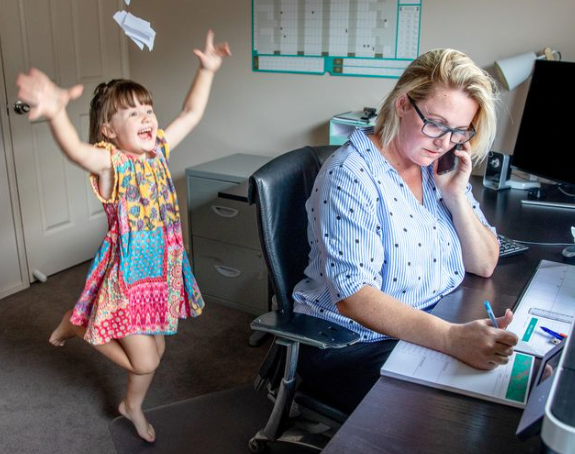
Working at home…. with the children!

It always sparks my interest when I’m delivering presentations about productivity and someone asks me a question that causes me to fumble for an ineffective answer! This happened just this week when someone asked me if I had any tips for working from home when you also have your children around. In my head I thought, ‘Hmmm no not really’! When you’re presenting you have to come up with something, so i did… and I have no idea what I said! So I thought… time to delve into the literature and she what people think in terms of tips for working at home when the children are around.

Obviously the first thing to say is that I suppose it depends largely on the age of the children. Younger children I imagine are more of a challenge than older children who, quite frankly, I’d think will be over the moon that you are distracted with work, which means you leave them alone! My ‘children’ are now adults so I have no idea. But thinking about them as teenagers, as long as they were fed and watered and the x-box was fully operational they probably wouldn’t have cared. Anyway! Apply these tips as you see fit!

Create a schedule

Now, as you can imagine I love this one! Create a schedule – well yes – you should have a schedule for everything, so it’s not a big leap to create a schedule for the whole family. Be clear about when it’s work time and when it’s time for ‘family’. I’d imagine with younger children you’ll need to have short time frames here so that they get to regularly check in with you. Children I find love routine so i can see how this idea might work.

How about organising what you are all doing on a timer so they can watch the countdown. This would make it fun and give children a visible cue. Hint: this works for us as adults as well in terms of focus and productivity (after all adults are just bigger children with responsibilities!) The schedule needs to be realistic.

Maintain the schedule

Its no good having a schedule if you don’t stick to it. I imagine as adults we are just as bad at this as our children are. So be clear and then deliver. You might need to work on this with colleagues and managers and colleagues and managers will need to on board. They need to be helpful as they are going to get the best out of you if they understand you, the demands on you, and how you are managing those demands – this includes what you need from them. So agree with them to switch off alerts during deep work and family time. You have to do your bit by being available consistently when you say you will be as well – balance is key here.

Here’s the other thing with your schedule. You might want to throw out 9 to 5. Again you need employer buy-in but it might be better for you to work in blocks with big gaps. Maybe starting earlier in the day might help. Crucially create pockets of time to work in that are engineered around the child’s concentration span not yours.

What about this….
6 – 7.30 Work
7.30 to 9 Family
9 to 11 Work
11 to 1 Family
1 to 3.30 Work
3.30 to 6 Family
6 to 7.30 Work
Now… this won’t work for everyone but shows how you can chuck out 9 to 5 and work differently

Start the day off right

I’m a big believer in us all starting the day off right! I’ve written about this here. Maybe get up earlier. This means going to bed earlier! But I guarantee that hour 6 till 7 in the morning is worth more to you than that hour 10 till 11 sat in front of another Netflix episode. Get out of those pj’s and get dressed – everyone – including the children. This signals that it’s time for something else. Have a morning routine that includes some dedicated family time so that the children have had your undivided attention before clearly indicating ‘time for work’ time to go with the schedule.

Designate work and play areas

Having a dedicated workspace is really important of you can. A separate study or office room is best but I appreciate not always achievable. You should not though be trying to work in the same room as the children. Obviously if they are young you will need to be close by but… not in the same room. You may be able to close the door (depending on the age of children again) and that should be a clearly explained signal that is ‘do not disturb’. You could enlist the help of the children to make signs for the door (even if the door can’t be closed) that signals ‘do not disturb’ or ‘come on in’. Enlisting the children in making these signs makes them feel part of what is going on.

Create a drinks and snacks station that the children know can be accessed without asking. Healthy snacks and drinks obviously! You use it as well so they see it as a family thing.

Have patience and make concessions

…and this is not just aimed at the worker but at the organisation as well.

As the parent be attentive to your child no matter what. Take a breath and listen, don’t be dismissive. I know you know this makes sense but I also know this is very difficult. I have to work on this even when an adult interrupts me when I’m right in the middle of something. But what I know is that getting irritated by the interruption only fuels stress, and stress fuels lack of focus and procrastination. Stop, attend, resolve, and move on.

Mangers and organisations…. plan further ahead – especially when you have people working at home with children. It’s a modern work place problem that we don’t plan far enough ahead. It’s not acceptable to crash into someones day. We know the importance of focus and concentration when we’re in deep work and how being interrupted creates low productivity. So, it’s a good habit anyway that you plan ahead as much as you can. Plan the conversations you need to have and plan when to have them so both you and others know what is expected and feel as much in control as possible. If you are constantly asking for last minute meetings you need to think about your workflow and planning. We have to start to think not just about what we need but about how the way we operate impacts on others. If we don’t do this we will never make hybrid working work effectively. Obviously sometimes there are things that you can’t predict and you have to interrupt people but that shouldn’t be the norm.

The key here is good communication in all directions. Be clear about what you are trying to achieve in your day and how you are going to balance things. Be clear about when you are available (or as a manager – when you need someone to available). No last minute surprises from anyone that are avoidable. Over inform rather than under inform.

….oh and you might want to relax your ‘screen time’ rules for your children 😉

Applying the 2-minute rule in practice – a beginners guide!

Every time I ask people to feed back to me after the sessions I do about self care and productivity about what they found most helpful they always mention the 2-minute rule. So… I always talk about it.

It’s basically this. If you look at a task and you think it’s going to take less than two minutes to complete then simply do it. Don’t delay, don’t put it off until later, just do it. You can actually achieve a lot more in two minutes than you think you can. If you have the time, sit quietly now for two minutes. It feels like forever! You could get a lot of small tasks done in that time!

At a session recently though someone suggested that the application of the two minute rule was in contradiction to my view that when immersed in Deep Work we should do it to the exclusion of all other tasks. “Surely the two minute rule contradicts this as if you come across something to do then you are suggesting I just do it”, the person said (I’m paraphrasing – but that was the gist of it I think). I answered something to the effect that the two minute rule was effective for emails and planning tasks and working through small tasks but not when engaged in deep work. I wasn’t satisfied with my explanation. I didn’t feel it was clear enough so I thought I’d write a blog.

There are times, like anything, when the application of an idea is helpful and times when it is unhelpful. The two minute rule falls into that category. I thought the best way to explain when to use it and when not to use it would be to take you through a typical day of mine and explore the application of this ‘rule’.

Start-up strategy

We all have a start-up strategy? Yes? This is the process that gets you going when you get to work. Just like a computer you need to be powered on and have your software loaded and get yourself ready for the day. My start-up strategy goes like this.

8.30 Open notebook to new page and write the date at the top then Open calendar. Work through the day visualising myself undertaking each task. In doing so I am connecting with the task and checking that I have everything to hand that I need for each task. This is a perfect opportunity to apply the two minute rule. If I find I haven’t got something I need for a task, maybe I haven’t created a Teams Meeting link or printed off some lecture notes or found a phone number I need, I apply the two minute rule and do it there and then. Anything else that’s longer than two minutes gets put in a time slot in my calendar (this doesn’t happen very often, if at all, as my planning strategy means that the big things required are all done)

9.00 Open Emails and work on getting my Inbox to empty. I work through my emails methodically one by one using the Do It, Delegate It, Defer It, Delete It process (see this link for more on this strategy). The Do It part relies exclusively on the two minute rule. Can I deal with this email in less than two minutes? If I can it gets done there and then. If it’s going to take longer than two minutes it gets deferred into my trusted system.

Working day

9.30 Clearing up and small jobs. This is a good slot for anything that might have fallen out of my diary scan and my emails. If something needed doing urgently I will have put it into this time slot. No two minute rule things here I’d imagine because this will be a longer task or tasks that needs doing

10.00 Deliver lecture. Off I go to do what I do. This is in many ways Deep Work. I’ll explain. Deep Work in the productivity literature is usually a job that needs you to be completely focussed to the exclusion of everything else and is usually best undertaken in glorious isolation – distraction free. Now that doesn’t define lecturing as you do it in front of people but I feel it is still a Deep Work task as it requires me to be completely in the moment to the exclusion of everything else. So no two minute rule activities going on here.

12.00 At the end of the lecture a student asks me for a tutorial. Yes indeed! Let’s plan that now. I have my calendar on my phone. Two minute rule applied tutorial booked. I could have said I’ll get back to you later with some times, but no, there and then – let’s get this sorted – done and forgotten about – my calendar will remind me of what I need to know.

13.00 Lecture Preparation (after lunch of course as a lunch break is so important – have a look here). This is Deep Work. I need to be in a quiet place and I need to be not distracted. I won’t be applying the two minute rule here because i will have switched my phone and emails to silent and I’ll be getting on with the task.

But disaster – there is a problem here. Our minds just don’t stay focussed on the thing we are doing no matter how hard we try. The more we do Deep Work and the more we train ourselves towards mindful behaviour the better we get at it but nevertheless sometimes something pops into our heads! This is what I refer to as a boundary moment. A point where we have a choice to make about how to proceed! What do we do! My brain has just reminded me that I was asked by my manager to email them the contact details of someone.

Now, that could be achieved using the two minute rule because it will take me less than two minutes to do that. But there’s a problem here because opening my emails and sending the information will only take that time up but I might see other emails that interest me – our minds are terrible like that – and I might end up replying because – well – I could do it in two minutes. We become trapped in our emails and the Deep Work gets interrupted and then, when we go back to the Deep Work, it takes (as an experiment conducted by Microsoft found out) 10 to 15 minutes to get back up to speed on the Deep Work task. So that’s not a good idea!

I could still decide to go and apply the two minute rule and get the email sent. It might be something really urgent and therefore the interruption may be necessary. I might have to accept the productivity dip.

But if it’s not urgent I should resist the urge to send the email now and continue with the Deep Work.

But problem number two raises itself! Every time I try to get on with the Deep Work task I keep thinking I mustn’t forget to send that email! Argh! David Allen calls these Open Loops. They just go round and round in your head taking up vital psychological capacity and distract you from the task in hand. Here’s what to do. Externalise your memory and make a note of what needs to be done in your note book that sits next to you all the time with today’s date at the top of the page. You sorted this out at 8.30 this morning during your Start Up strategy! Note: Send email to manager with contact details for Dave. This gets it out of your head into your trusted system so that you will be reminded to do it later. It does create a pause, it does create a shifting of attention, but you have minimised it as best you can. We can’t help these thoughts encroaching but we can decide how to mange them for the best.

15.00 Team Meeting. I class this as a Deep Work task as well. The meeting needs my attention so no two minute rule opportunities here. The same rules apply that we utilised when we were doing lecture prep Deep Work. As you go through the meeting take notes about things you need to to do so we can move them into our trusted system later.

Shut down strategy

16.00 Emails. This is the same process that we undertook at 9 a.m. Open up those emails work through them and get that Inbox to empty!

16.30 Planning. Getting in to empty is not just about that Inbox it’s also about that note book and all of the entries you’ve made as the day has gone on. You work your way methodically down the list and use the same Do It, Delegate It, Defer It, Delete It process that you used for emails. Note: Send email to manager with contact details for Dave. Two minute rule application! This is where that deferred task gets done in two minutes having caused the minimum of disruptions to your Deep Work. Then, go through the other tasks that you’ve noted in the same way. They either get done, get deleted, get delegated to others for more information, or get moved into your trusted system as entries in your calendar. Cross them out as you go – it’s soooo satisfying! Finally plan tomorrow. Have you got everything you need for everything you need to do. Get all of your ducks in a row.

17.00 Reflect on the day. What didn’t go so well. Could you have controlled something better or could you not have foreseen what went wrong. If you could have done something better jot down what you could have done. This helps consolidate your thinking. If you couldn’t have predicted what went wrong then let it go. It is what it is. Then think about the things that went well, and the things you got done. This is especially important if you have had a stressful day (….there are other sorts of days I hear you say!) When we are stressed we tend to take a micro view of our day, homing in on small details and this can lead to negative thinking. Get your wide angled lens on and take a birds eye view of the day and enjoy the things that went well…. and then Shutdown Complete.

Like any technique it only works in the right circumstances. The two minute rule needs to be used when it is appropriate and not used indiscriminately when it will interrupt your Deep Work. Unless of course the thing that popped into your head is so important that you should interrupt what you are doing and get it done!

Over to you!