Student zone: Take note(s)… a skilful art!

People climbing books. isolated on white background. Vector illustration. Eps 10

What is at the root of academic success.

As a lecturer in Social Work at Sunderland University I get to talk to, listen to, and observe students going about their business. I watch them in my lectures writing copious notes generally thinking, ‘my goodness! Don’t write down and rely on anything I say!’ Self deprecating humour is my go to place! Such things lead me to consider note taking and academic success. I myself often take notes and having read the wonderful book ‘How to Take Smart Notes’ by Sonke Ahrens, I realise there’s more to it than meets the eye. My musings here are largely from or driven by that book. Here are some things to consider.

IQ does not drive academic success – what drives academic success is what you do day in day out

In order to learn you must strategise your learning – it’s not something that happens by chance. What leads to success is how you go about your everyday work and what you do day in day out will affect the quality of your assignments, rather than just what you do when you’re writing the assignment.

Success depends on the environment you create externally and internally

Where you work and how you work – and how you feel about work – will dictate the quality of the work. There’s a well researched phenomena which goes that if you work in a cluttered environment you will think in a ‘cluttered’, messy, way. This applies not only to your desk but also to where you store your files, how you structure your folders on your computer, and generally how you go about storing all manner of things that you need to support your success. Your internal environment is also important. How you feel on the inside. Do you feel alert or tired, sluggish or enthusiastic? Have you set an effective approach goal? Approach goals are about setting positive thoughts in motion. Students who set avoidance goals – ‘I just don’t want to fail’ – rather than positive approach goals – ‘I want to do my best’ – actually do worse in assignments research has shown as a consequence of this avoidance thinking. Positive mental attitude isn’t a silver bullet but it sets out a pathway.

Learning is cumulative and connected

When we’re taking notes and reading books and generally going about our business of studying we need to connect our ideas in some sort of system so that we can see what links to what because, as you may have noticed, ideas are connected and build on each other. Theory influences practice, practice helps us consider methods, methods are influenced by theory – and so it goes. If you watch University Challenge you’ll spot that sometimes they know the answer but often they don’t but they work it out from other things they know.

Insight only comes from exposing yourself to volume of material

I often say at induction events and during lectures that those who do the best are those that read the most. You have to expose yourself to a range of ideas and often to the same idea in different places until you hit a light bulb moment. You have to put the graft in. If you wanted to grow bigger biceps you couldn’t get someone else to go to the gym for you and do barbell curls you’d have to go to the gym yourself and you’d have to go more than once!

Notes

When it comes to taking notes there are two key places to consider

In Lectures

When Reading

In Lectures

Firstly, we can’t multitask effectively. If you are trying to write everything down then you risk missing what’s been said. Whatever you do in class or when watching a video lecture be in that moment – phone away and on silent, distractions eliminated. Don’t try to capture everything – capture only the key points. Use bullet points and short phrases to signpost yourself to further reading.

Note down things you didn’t understand (ask questions in class if you can) and then follow up with reading the things you found difficult – you will find things difficult that’s fine!

Do these things:

  • Arrive in time to be settled
  • Title and date your notes
  • Be ready to focus completely – set a positive attitude – a positive approach goal
  • Develop abbreviations for yourself that you always use to speed things up when note taking
  • Highlight, underline, and capitalise to add emphasis to key points etc. I use arrows to connect points a lot
  • Use headings and sub headings. Have one point per line and leave gaps to add things in

Then, crucially, return to your notes    

The important thing to do is to go back to them as soon after class as possible and review and re-write them adding in other things you remember and then using the guided reading (where there is some),or relevant texts you find yourself, to embellish and enhance what you have noted down. You should undertake this review within 24 hours – sooner if you can. So plan this time into your calendar. This cements learning. Repetition is everything.

Review your notes periodically. When you type up the next notes look through all of the previous notes – this establishes those connections – write the connections down!

When Reading

Read with pen in hand and note or underline (not on the library books obs! Maybe use post-it notes). Once you’ve done this you must do something with these notes and underlines

Be aware that reading is a skill. Different texts require different approaches, some take longer to read, some can be scanned through, and when reading some you need to go off and look things up that you don’t understand. This is completely normal. Don’t panic.

Write up your notes and underlines
Your on-going understanding is reliant on external scaffolding. If you want to really understand something turn it into your own words. Just copying down quotes can risk stripping them of their context and therefore their meaning (and can risk plagiarism). Always write down the outcome of your thinking. This is about having a meaningful personal dialogue with the text.

Writing down is not a record of your thinking it is your thinking
“I’m never sure what I think until I see what I write” Carol Loomis (American Journalist)

Take notes…. consolidate notes…. read your notes… connect your notes…. tell it to yourself (I do this when I’m walking the dog! In my head not out loud!)

Deliberate practice is the only serious way of becoming better at what we are doing. To be good at writing you don’t just write when you have an assignment to do – you need to practice writing, and you can do that when sorting out your notes into a meaningful system!

Stephen is a Lecturer in Social Work at University of Sunderland. He’s a bit obsessed with self-care, well-being and productivity and writes about those things on here in the productivity section and on our sister site Self Care Shorts

The transition problem – student to practitioner

In their book ‘The Lost Art of Running’ Shane Benzie and Tim Major talk about research that was undertaken with athletes that sought to explore their running gait and style. The research was conducted indoors on a treadmill so that the researchers could control conditions. They watched the athletes and learnt lots about how they ran and offered suggestions to improve. They runners got better at running.

They then moved outdoors and…. the improvements disappeared. The changes didn’t work the same. Because outdoors – real life if you like – isn’t the same as in the lab. The runners still used what they had learnt but had to re-engineer and, in some cases, relearn some of what they knew. Social Work is the same. What you learn at University and what you learn on placement gets you through the door and you then need to transfer that knowledge into the real world of practice.

Croisdale-Appleby noted this in the 2014 report Re-visioning Social Work Education and said ‘the first year of practice is absolutely vital for social workers as they consolidate the learning from their degree and develop new knowledge and skills in their first employment setting’

Playing the guitar

Let me give you another example. I’m a guitarist and have taught many people over the years to play the basics. If I was to hand someone a guitar they would intuitively know what to do with it…. to a point. They would know not to try and blow into it like it was a wood instrument. They would know it wasn’t something to help them with cooking. They would probably pluck the strings. I’d then teach them a little theory. Which string needs to be tuned to which note and what shapes to place your fingers in on the fret board to make chords to strum. We’d then practice. We’d replay, over and over again, the same shapes and learn to change between them. Over time we’d learn to play a song with the chords we had learnt and invariably the student says I’d like to play ‘song x’. So you look at ‘song x’ and realise that the guitar student knows most of the chords but needs the chord of F to play it all. F is not an easy chord for a beginner. They feel like they are back to square one and their confidence takes a knock. But over time (a long time) they overcome this, learn F, and a whole other set of chords, and they become proficient enough to play with other people and maybe join a band. They have to learn to then play in time with others… this is not as easy at it sounds. Then… someone might ask them to improvise a guitar solo which they’ve never done before so they use their intuition! ….based on the theory they know and the practice they have done Full circle! And the first time they do it it may well be alright but it might not be brilliant but they’ll practice and it will get better

Intuition > Theory > Practice > Time > Intuition (or as we call it Practice Wisdom)

Starting in practice

Evidence from Grant Sheridan and Webb (2017) suggests that newly qualified social workers felt ‘quite well’ or ‘very well prepared’ for practice in general. However, when this is broken down into preparedness for specific tasks, confidence levels drop. Essentially I’d suggest this is because specific tasks are often context specific (the type of social work you are doing and the organisation you are doing it in) and role specific – that is – not generic. You have to reapply the skills from the treadmill on the outdoor running track.

The conclusion of formal social work education is only one layer of the learning experience which is continuous throughout your career (or should be).

They also found that respondents felt most prepared to ‘promote and enable’ (89 per cent) and least prepared to ‘intervene and provide’ (32 per cent). Again because intervene and provide is context specific whereas promote and enable has a more value base feel about it. Respondents in the study reported feeling ready to conduct assessments, build relationships and communicate but less prepared for commissioning services and dealing with IT systems. Well they would because you can’t teach this as it is too organisation specific. They said they felt prepared for applying theory and demonstrating values but not for caseload management. It’s not the face to face work that seems to cause the stress but the ‘office’ function the research tells us.

The Dunning-Kruger effect

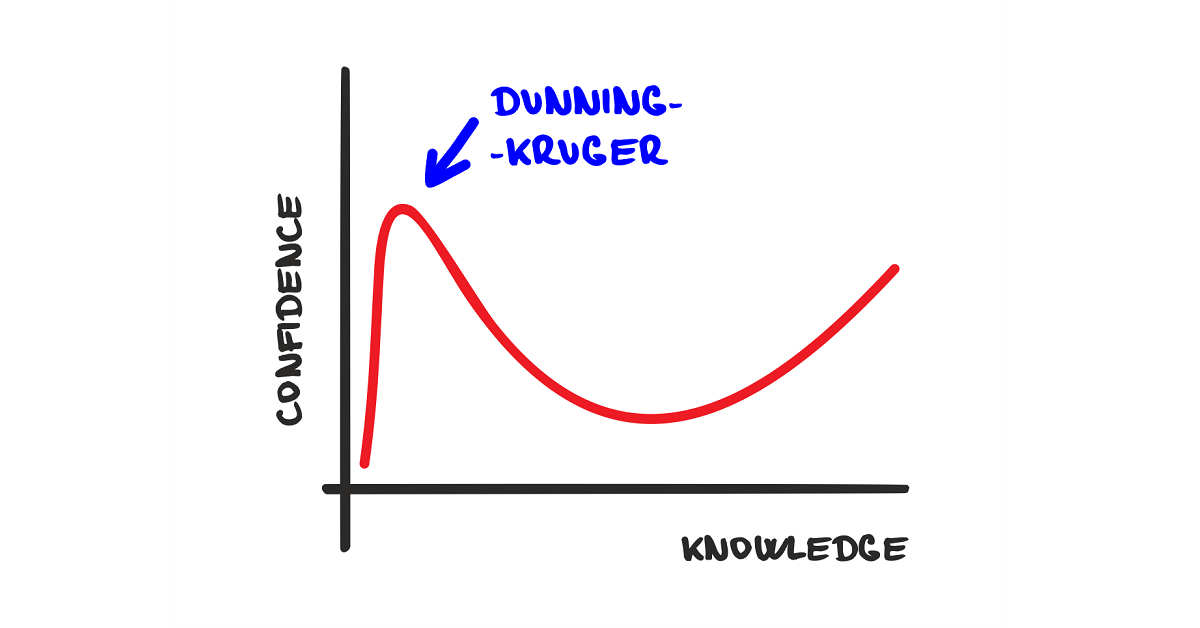
There is also something else going on that relates to the Dunning-Kruger effect. There are certain points in our lives where we are likely to overestimate our abilities and feel quite confident. Usually when we have achieved something that has taken great effort. Like completing a degree or securing a promotion or becoming a manger… or becoming a lecturer! The problem occurs when you transition from something where you are at the top of your game and you have to translate that knowledge into something else. This transition tends to undermine your confidence and you feel like an imposter.

Objectivity's Blind-Spot: The Dunning-Kruger Effect | Procrastination.com

Moving from being a student into practice is one such transition. You’ve just graduated and you know loads of stuff. You’ve just had a great placement and a got a good mark for your dissertation and then you have to translate the knowledge you have (which is valuable) into the new practice environment. You are likely to feel immediately out of your depth and like you know nothing and your confidence will take a hit.

At this point you need to remember some things. This feeling is completely normal for us all, to one degree or another, when we transition. You do know loads of stuff you just need to rework that knowledge into a new environment – stay calm. When transitioning it’s essential to stay focussed and organised. You are going to have to ‘lean into’ this for a while and it will take pretty much all of your energy. As in the diagram above your confidence will take a hit but apply the theory, engage in practice, take your time, and you will develop the practice wisdom to climb up that curve again….. and next time you transition you are likely to have to go through the same process again! Joy!

Remember your degree can not completely prepare you. It can only give you what you need to get started. It gets you the key to the door. Like people say about driving a car. You only really learn to drive a car after you’ve passed your driving test. This is the same. You are qualified, you are good enough, you can do this… but… the transition is going to be difficult and now you know that you can prepare for it.

  • Have growth mindset, a positive attitude, and that will help.
  • Keep on top of your planning and organisation and take time out for yourself.
  • Don’t lose yourself in the transition.
  • Work with your manager and mentor in an honest way and seek out support.

Whenever things are changing those who create as much order as possible do the best.

References:

Newly Qualified Social Workers’ Readiness for Practice in Scotland Scott Grant, Lynn Sheridan and Stephen A. Webb British Journal of Social Work (2017) 47, 487–506

Croisdale-Appleby, D. (2014) Re-Visioning Social Work Education: An Independent Review, London, Department of Health