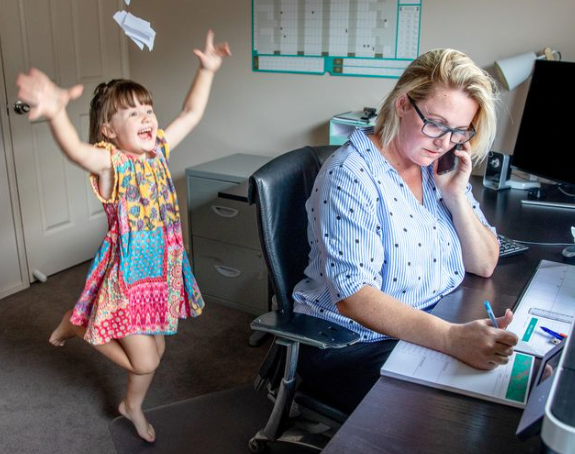
It always sparks my interest when I’m delivering presentations about productivity and someone asks me a question that causes me to fumble for an ineffective answer! This happened just this week when someone asked me if I had any tips for working from home when you also have your children around. In my head I thought, ‘Hmmm no not really’! When you’re presenting you have to come up with something, so i did… and I have no idea what I said! So I thought… time to delve into the literature and she what people think in terms of tips for working at home when the children are around.
Obviously the first thing to say is that I suppose it depends largely on the age of the children. Younger children I imagine are more of a challenge than older children who, quite frankly, I’d think will be over the moon that you are distracted with work, which means you leave them alone! My ‘children’ are now adults so I have no idea. But thinking about them as teenagers, as long as they were fed and watered and the x-box was fully operational they probably wouldn’t have cared. Anyway! Apply these tips as you see fit!
Create a schedule
Now, as you can imagine I love this one! Create a schedule – well yes – you should have a schedule for everything, so it’s not a big leap to create a schedule for the whole family. Be clear about when it’s work time and when it’s time for ‘family’. I’d imagine with younger children you’ll need to have short time frames here so that they get to regularly check in with you. Children I find love routine so i can see how this idea might work.
How about organising what you are all doing on a timer so they can watch the countdown. This would make it fun and give children a visible cue. Hint: this works for us as adults as well in terms of focus and productivity (after all adults are just bigger children with responsibilities!) The schedule needs to be realistic.
Maintain the schedule

Its no good having a schedule if you don’t stick to it. I imagine as adults we are just as bad at this as our children are. So be clear and then deliver. You might need to work on this with colleagues and managers and colleagues and managers will need to on board. They need to be helpful as they are going to get the best out of you if they understand you, the demands on you, and how you are managing those demands – this includes what you need from them. So agree with them to switch off alerts during deep work and family time. You have to do your bit by being available consistently when you say you will be as well – balance is key here.
Here’s the other thing with your schedule. You might want to throw out 9 to 5. Again you need employer buy-in but it might be better for you to work in blocks with big gaps. Maybe starting earlier in the day might help. Crucially create pockets of time to work in that are engineered around the child’s concentration span not yours.
What about this….
6 – 7.30 Work
7.30 to 9 Family
9 to 11 Work
11 to 1 Family
1 to 3.30 Work
3.30 to 6 Family
6 to 7.30 Work
Now… this won’t work for everyone but shows how you can chuck out 9 to 5 and work differently
Start the day off right
I’m a big believer in us all starting the day off right! I’ve written about this here. Maybe get up earlier. This means going to bed earlier! But I guarantee that hour 6 till 7 in the morning is worth more to you than that hour 10 till 11 sat in front of another Netflix episode. Get out of those pj’s and get dressed – everyone – including the children. This signals that it’s time for something else. Have a morning routine that includes some dedicated family time so that the children have had your undivided attention before clearly indicating ‘time for work’ time to go with the schedule.
Designate work and play areas

Having a dedicated workspace is really important of you can. A separate study or office room is best but I appreciate not always achievable. You should not though be trying to work in the same room as the children. Obviously if they are young you will need to be close by but… not in the same room. You may be able to close the door (depending on the age of children again) and that should be a clearly explained signal that is ‘do not disturb’. You could enlist the help of the children to make signs for the door (even if the door can’t be closed) that signals ‘do not disturb’ or ‘come on in’. Enlisting the children in making these signs makes them feel part of what is going on.
Create a drinks and snacks station that the children know can be accessed without asking. Healthy snacks and drinks obviously! You use it as well so they see it as a family thing.
Have patience and make concessions
…and this is not just aimed at the worker but at the organisation as well.
As the parent be attentive to your child no matter what. Take a breath and listen, don’t be dismissive. I know you know this makes sense but I also know this is very difficult. I have to work on this even when an adult interrupts me when I’m right in the middle of something. But what I know is that getting irritated by the interruption only fuels stress, and stress fuels lack of focus and procrastination. Stop, attend, resolve, and move on.
Mangers and organisations…. plan further ahead – especially when you have people working at home with children. It’s a modern work place problem that we don’t plan far enough ahead. It’s not acceptable to crash into someones day. We know the importance of focus and concentration when we’re in deep work and how being interrupted creates low productivity. So, it’s a good habit anyway that you plan ahead as much as you can. Plan the conversations you need to have and plan when to have them so both you and others know what is expected and feel as much in control as possible. If you are constantly asking for last minute meetings you need to think about your workflow and planning. We have to start to think not just about what we need but about how the way we operate impacts on others. If we don’t do this we will never make hybrid working work effectively. Obviously sometimes there are things that you can’t predict and you have to interrupt people but that shouldn’t be the norm.
The key here is good communication in all directions. Be clear about what you are trying to achieve in your day and how you are going to balance things. Be clear about when you are available (or as a manager – when you need someone to available). No last minute surprises from anyone that are avoidable. Over inform rather than under inform.
….oh and you might want to relax your ‘screen time’ rules for your children 😉