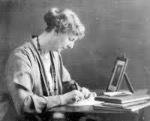
1895 London, Mary Stewart walks into work in her new role as hospital almoner (churchy term for some one that gives out charity/alms to poor). With this the profession of social work was born.
Mary, made referrals, conducted home visits, trained aspiring social workers, battled against bureaucracy, worked with drug and alcohol misuse, mental health problems and child abuse.
Sound familiar?
Mary’s work had a laser focus on poverty, with her work based on hospital patients that were too poor to afford treatment (the NHS coming 60 years later). She saw poverty as a major causal factor, heavily linked to health and wellbeing and the safety of children.
It seems after hiring the services of the Third Sector ‘007’ Josh McAllister and this week the publishing of Kingston upon Hull University’ findings we have amazingly come to the same conclusion as the first social worker 125 years ago. The Hull report found that Children in the poorest areas are 14 times more likely to be referred to social care than children in the richest areas. Simply, its not who your parents or family are its your postcode.
Can social work be boiled done to the simplest equation?
POVERTY = bad outcomes for children and families + Social Care intervention.
Mary’s work chronicled the lives of London’s poor in her own recording system, The Almoner’s Handbook. It highlighted poor living conditions, lack of funds to purchase quality nutritious food and a lack of social and employment opportunities.
Imagine Mary working solo in one of the biggest cities in the world, on a daily basis observing the relentless anguish caused by poverty but being powerless to change the labour market, housing, the price of alcohol or the availability of fresh fruit and vegetables.
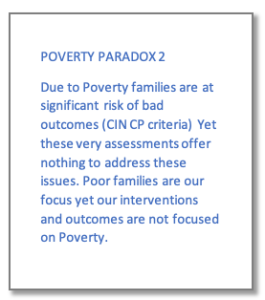
Are we equally stuck in 2021 as social workers, merely typing up the misery of people’s lives into computers with no leverage to hack at the root causes of poverty?

Despite being a trailblazer Mary was still a product of her time and the discrimination of the deserving and undeserving poor was evident throughout her work.
In one example she refused to assist a Lady who was found to be “gossiping in the street”, whilst another who was extremely grateful to speak to Mary received a waterbed, free GP visits, and a trip to the seaside. However, let’s not pretend as social workers we don’t find it easier to advocate for families that we have a better connection with or are in some way fond of.
Or should we ask our selves a harder question? Is sexual abuse, emotional harm and domestic violence evenly spread in households regardless of income. For example, the middle-class professional father who enacts such violence on his wife and children and then often himself, is strangely never regarded as a social care issue.
Are there any answers?
Our Assessments
There is now an extensive evidence base in the UK around the impact of poverty including, life expectancy decline, limited healthy life expectancy, poor health outcomes for children, problematic mental health, and poor social mobility.
Yet do we own this evidence in our assessments? Do we in our analysis place the responsibility solely on parents, when our Child Protection caseloads are often situated (the vast majority of the time) on a select few estates in our Local Authorities rather than spread equally or randomly.
To call this out I feel we need to be brave and start using sentences such as the following in our assessments,
Whilst these parents have made negative choices and are responsible for the consequences these have had on their children, the impact of poverty and poor access to mental health services and improved work prospects have had a demonstrable negative impact on this vulnerable family.
Whilst the interventions offered have improved some aspects of parenting capacity, the lack of good schooling, positive local role models and access to pro social activities are likely to play a far greater role in the long term outcomes for this family.
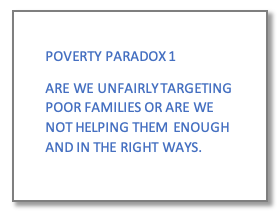
As Kingston upon hull (2021) have evidenced this families poor financial circumstances have increased their prospects of being involved with social care and having concerns investigated irrespective of any individual features or characteristics.
Whilst this feels a radical step, if it’s true and evidenced based, are we not duty bound in terms of our professional standards to seek to include this in our work? Or, we are just playing a professional version of the Emperor’s New Clothes fable. Or even worse are we playing Mary Stewarts game of feeling that the families we work with are somehow bad or undeserving of good outcomes.
Situated choice
Micheal Blastland’s book the Hidden Half, raises a potential area that social workers can seek to explore to offer a ladder out of the poverty trap, using the lens of escaping a life of crime.The Hidden Half discusses the Shared Beginnings, Divergent Lives study. The study offered a longitudinal investigation over a 70 year period, with the focus being on following up life outcomes for boys in borstals in the Boston area in the 1940’s.
The basic question was who continued to offend and who turned their lives around despite the bad start. The crucial question, however, was what made the difference in those that turned their back on a life of crime.
Did Mary Stewart wonder about her families that she visited, comparing the ones who did slightly better or managed to get out of the slums with the ones who lived short harsh miserable lives (as the majority did). Possibly like social work Mary never got to see the success stories as they would naturally not be in need of her services as much due to their improved lives.
Micheal Blasland points out that the team, when looking at the data, could find no statistically significant correlation between any variable (education level, zip code, marital status or type of offence). It seemed it was just the roulette wheel of life – RED or BLACK – return to prison or a happy and long family life.
The researches were totally stuck until they started visiting the 70 year old men by physically tracking them down (no mobile numbers in the 1940’s etc). What they quickly discovered was that the men who never returned to crime each had a story about a ‘Sliding Doors’ moment when they made a clear life choice.
One example was a man returned home to his wife after a hard day at the saw mill –
“I hate this job I could make ten times back in the gang”
To which his wife replied,
“Quit the job and I quit this marriage”
From that point on the guy stayed in work and was never arrested again.
Others talked about solemn moments where they considered joining the army and made a life changing positive decision for themselves, or hard work and chance encounters offering up opportunities that they grasped with both hands.
In short, they all recalled making life changing situated choices that set them on a different life trajectory.

To give a current example the England forward Raheem Sterling’s success can be tracked down to two situated choices. One, his mother making the decision to leave the family home in a poor and violent area of Jamaica to live in the UK when Raheem was 4 and the other when Raheem’s behaviour was unmanageable at home and a youth worker in a residential project had the idea of a football match in the local park. Should he ask Raheem, could Raheem be bothered to go to the park, are the questions that would of swirled around their heads. The rest is history, Raheem made a positive situated choice when he very easily could have refused.
So, what has this got to do with social work?
I feel the issues we address such as child abuse, alcohol abuse, domestic violence and mental health can often lead to a narrow focus which only serves to narrow the opportunities for positive change. People are never single issues solutions and interventions should not make this mistake.
I would suggest we consider this. When a case is allocated look at how many assessments have predated yours. How many times has the traditional Children Act led intervention been meted out with no or little lasting change?
For example, would the father who has been suffering from depression benefit from an engaging employment skills course or clearing his debt. Are these actions more achievable and more beneficial than a long NHS waiting list and short course of CBT? Or would a young mother who is socially isolated and struggling with their child’s schooling not benefit from volunteering a few days a week at the child’s school.
Do our interventions open doors up to families or do they just seek to close the Child in Need or Child Protection door behind them when they scrape through our artificial risk threshold. Whilst any intervention we offer can end up in a dead end, should we not seek the ones that would maximize the potential of the individual and their families, supporting situated choices.
Crucially I am not denigrating mental health support and traditional services, I am just suggesting that if we don’t support an expanding of horizons and options for families we are doing no better than Mary Stewart visiting the same poor families to offer help that are living in conditions they have no means to escape from.
As social workers we must believe that all families are deserving of enhanced life options. We need to be willing to explore creative options and take a chance to jointly develop a map out of their current circumstance and hopefully that may create at least some lasting change.
About the writer…..
George Bull
George has been a social worker for 10 years working mainly in child protection and Early Help. He has lectured with Jamie Scorer at New College Durham, University of Sunderland and University of Northumbria in solution focused practice.