Language and Power in Social Work, a fresh perspective from the Philosophy of Ludwig Wittgenstein

Social work can be seen as an endeavour of attempting to grasp at another person’s reality. We assess people and families striving to be as faithful as possible.  In this article I will discuss how Austrian philosopher Ludwig Wittgenstein may assist in providing some warnings and possibly a map of where the limits lie in attempting to describe another human’s existence.

Wittgenstein is often seen as a totally impenetrable and unnecessarily difficult thinker, whose tomes are the jealous property of grey faced professors at posh Universities.  I aim to hopefully present some straightforward uses for his philosophy on language and how it can help social work practice.

Life and Times

Wittgenstein’s life story would not fit into one film! Don’t believe me? Here goes!

He was born into a large super wealthy Jewish family in Austria with their wealth matched only by the Rothschild’s (them of the Illuminati). He went to primary school with Adolf Hitler.  As a toddler he made machines out of scrap discarded items in his home, he designed a new method to heal wounds after car accidents, he invented the corner radiator, created a precursor to the jet engine and liked a pint round Jesmond when working in the RVI.  Despite this list he was the least famous member of his family. One his brothers was the best concert pianist in the world which he did playing only with one hand (strangely there is an episode of MASH based on his life).

Despite his wealth he left the 7 palaces and even more grand pianos (his siblings had one each) and served in the first World War with him single handily diverting machine gun fire on the Russian front and being awarded medals for bravery. During this time on one of the most brutal campaigns in WW1 he wrote one of the greatest works of philosophy the Tractatus.

However the true genius of Wittgenstein is that he is two philosophers in one as his later work comes to re-meet and reinvent (or more accurately decimate) his earlier work, with this hinging on language being variously limited, meaningless and redundant.

Our Language Affects What We See - Scientific American

Language according to Wittgenstein is best seen, and perhaps can only be seen, in the context of a game, with a game being described as an activity where participants have a pre-understanding of some commonly held rules. The important point here is the meaning is held only between the active participants. To an outsider it is meaningless.

This chimes exactly with a recent Radio 4 documentary about a young parent’s experiences of the family court where their children are removed. One quote in particular about the barristers and the social worker struck me – “it was like a play where everyone but me had a script and knew their lines but me(sic)”.

This highlights a true Kafkaesque nightmare. This parent does not understand the very language that is being used to deny her of her most basic right to be a mother to her child.  How do we, in the most caring of professions, engage in such a cruel language game?

It is highly likely that the barrister, the judge and the solicitors have never seen one second of the parent being a parent yet they are able to make complex arguments, statements and decisions on that very matter.  Their Jargon is as removed from the reality as their experience is.  ­­­­The below attempts to formalise this picture.

This frames language as being the main agent of oppressive practice. Power is held by those whose professional and remote jargon trumps real experience every single time.  This reminds me of an old thought I had at my first Section 47 strategy meeting when I realised (despite being a newly qualified worker), I was the only person in the room to have seen the family, but everyone else’s perception held much more sway and influence.  What a strange set of affairs! It’s all a bit like reviewing a film without seeing it. At best you will only offer a derivative generic version of what’s come before, which is shorthand for terrible social work practice, “I don’t need to visit the family I have worked with neglect etc for over twenty years” is surely the defence of the team manager.  Do we overvalue an argument from career experience at the expense of the view from the practitioner who has seen the “whites of the family’s eyes” and visited their home? If good social work aims to get to the essence or the true nature of a child and their family’s life this cannot be done from a remote place. You’ve got to be sat at the board to play the game.

Wittgenstein provides a good example that chimes well with social workers, that of the family resemblance.  Look at the family picture below:

It is clear that they are all related and resemble each other; however their quality cannot be pinned down to a few simple elements. It is a collective range of positive and negative features that create a very real but fuzzy concept.  This feels familiar. As social workers we often have to describe things like the mood in the house or the relationship between individuals, how close are we getting to the real picture, especially when we only demonstrate our evidence through written assessments.

Indeed, as social workers we must be cautious that whilst we strive to understand the context of the child and the parent, our language can only grasp at their reality fleetingly. To say we have fully captured (the language of a bounty hunter??) the child in our assessment is to crush their experience into oblivion. ‘I know better than you about your own experience’, is a disturbing thought in the extreme. Conceptually this can be seen as Naïve Realism (see poster). My world view is the solely correct one.

I’ll close on one of Wittgenstein’s most famous quotes, “If a Lion could talk, we could not understand him”

The message here hinges on a double meaning of understanding. Whilst we could understand the grammar, words and sentences if the lion spoke perfect English all of the common concepts would not be shared ones. Their lives as a lions are inaccessible to ours as humans with no common rules for the exchange.

Luckily as social workers we do not have such a chasm to cross, however, we must acknowledge there remains differences and fuzziness that cannot be fully held by our assessment and certainly cannot be got at remotely by professionals who have never met the family. So, tread carefully, meet families where they are (actually and figuratively) and be cautious of language’s exclusory and assumptive power.

You might also like the following from George and the Social Work Shorts Team talking more about Wittengstein’s Lion

https://anchor.fm/socialworkshorts/embed/episodes/Social-Work-Shorts-Episode-10-Presents-Beers-and-Ideas—Philosophy-and-Social-Work—Wittgensteins-Lion-e10sbfi

George talks about Poverty in this Social Work Shorts Podcast

https://anchor.fm/socialworkshorts/embed/episodes/Social-Work-Shorts-Episode-15-Insights-1—Poverty-and-Children-and-Families-Social-Work-e14i2k7

Or listen to George talk to Stephen about Risk

https://anchor.fm/socialworkshorts/embed/episodes/Social-Work-Shorts-Episode-25-Insights-8-Stephen-in-conversation-with-George-Bull-about-Risk-in-light-of-the-murder-of-Arthur-e1bfo48

About the writer…..

George Bull

George has been a social worker for 10 years working mainly in child protection and Early Help. He has lectured with Jamie Scorer at New College Durham, University of Sunderland and University of Northumbria in solution focused practice.

Thoughts on ‘Radical Perspectives On Mental Health’

I had the luxury of a spare Saturday yesterday (12th February 2022) that coincided with an online festival of presentations and discussion on all manner of things from philosophy to science, all the way around culture and back again. It was the Winter Revel brought to us by How The Light Gets In.

I’ve been to one of their online festivals before and loved listening to people who were new to me and people whose books I’d read. They have some ‘heavy hitters’ on the bill. 

Lucy Johnstone | In-depth interview

I was so pleased to listen to Lucy Johnstone’s (left) take on Mental Health…. a radical take, as she put it, in many ways. Lucy is is a UK clinical psychologist, trainer, speaker and writer, and a long-standing critic of biomedical model psychiatry. She has worked in adult mental health settings for many years, alternating with academic posts.

She said a number of interesting things that critique the current professional and public perception of mental health that I am still thinking through for myself but I felt were worthy of getting out there for further exploration. You can comment below or join the chat at our Social Work Shorts Discord server – you’ll need to download the app or desktop version and then follow this link. 

So what did she say!?

She started by quoting Dr Allen Francis the chair of the DSM IV Committee (the mental health diagnostic manual) as saying ‘there is no definition of a mental disorder ….it’s bullshit.’ Johnstone was keen to point out in saying this and the other things she said she wasn’t denying the very real and problematic experiences that people have. She was simply suggesting that we are approaching it in the wrong way ….and she did offer a solution which I’ll get to later. She confirmed the view of Francis stating that diagnosis is not scientifically valid saying that diagnosis is circular. You’re hearing voices – you have schizophrenia – how to we know you have schizophrenia – you’re hearing voices etc. This points to the fact that mental health diagnosis is social not medical. The person doesn’t fit with what society perceives as ‘normal’.

She went on to suggest that psychiatry rarely helps people. She wasn’t saying that it sometimes didn’t help but that mostly it doesn’t. In fact she suggested that psychiatry can sometimes reinforce the stigma that goes with having a mental health problem. She suggested also that well intentioned anti-stigma campaigns often do quite the opposite and reinforce the ‘othering’ of people with such ‘problems’. They are based, she feels, on an illness model rather than a model that centres emotional suffering. She noted that the mantra ‘we all have mental health’ elevates the normal range of emotions and feelings to a higher level and problematises or medicalises a range of feelings that sit within a ‘normal’ range. Again she was not saying that people with emotional difficulties should not be supported but rather that the elevation is inappropriate for many. Self diagnosis is unhelpful and also so is the over medicalisation of a range of emotions.

The problem with diagnosis and the diagnostic manual she suggests is that 9 out of 10 of us at some point will meet the criteria for one or other of the ‘mental illnesses’ so eventually it will be 10 out of 10 so then we all are mentally ill and systems get overwhelmed and people that should be at the top of the priority list for support don’t get it. Of course such over diagnosis plays right into the hand of pharmaceutical companies who can offer us medication.

In relation to current treatments she makes the startlingly obvious point that is overlooked that despite such treatments rates of distress across the world are rising. So if what you’re doing isn’t working maybe it’s time to do something different.

First of all what is the problem!?

She suggested that economic conditions brought about by neoliberalism had created job insecurity, reduced welfare services, reduced community ties, excluded some groups and led to materialist values which in turn has led to an increase in mental health problems. It takes me back to a quote from Alvin Toffler that I often use from his book Futureshock written in 1970. He predicted that the change of pace he saw then would continue into the future (our present) and people wouldn’t be unable to keep pace with the change. Add into this Debord’s view in his The Society of the Spectacle that people’s worth will become tied up not in what they ‘are’ but in what they have. This leads to a drive to consume more and more to signal to others our success. This creates a tension that he refers to as an ‘opium war’ that forces people to equate goods with satisfaction. Mental health ‘problems’ are therefore rooted in a social phenomenon that has a psychological impact. This requires us to change the social world to make it a better ‘fit’ with the universal human condition

Johnstone, with Mary Boyle propose in their book ‘A Straight Talking Introduction to the Power Threat Meaning Framework: An alternative to psychiatric diagnosis’ an alternative. The framework mentioned in the title Power Threat Meaning.

The framework haas been developed by a core group of psychologists and service users over a 5 year period laying out the following key principles. The framework builds on trauma informed practice, de-medicalises and de-professionalises mental health intervention, explores how distress makes sense in a context and creates no separate group of the mentally ill.

The framework asks some core questions:

  • What has happened to you? (How is Power operating in your life?)
  • How did it affect you? (What kind of Threats does this pose?)
  • What sense did you make of it? (What is the Meaning of these experiences to you?)
  • What did you have to do to survive? (What kinds of Threat Response are you using?)
  • What are your strengths? (What access to Power resources do you have?)
  • and to draw it all together What is your story?

Johnstone suggests that this framework draws on the importance of the group to the individual, acknowledges our relationship tot he natural world, integrates mind, body, and spirit with that natural world and builds on (among other things) community narratives and values.

Now if like me you’re a social work you’re probably thinking…. that sounds like it aligns with social work practice and values very well to me! What do you think? Hearing Lucy Johnstone talk about this felt like turning a corner and was so refreshing. Check out the book. It’s available here from the publishers web site and all the other usual places.

A Straight Talking Introduction to the Power Threat Meaning Framework: An alternative to Psychiatric diagnosis 9781910919712

Motivational Interviewing – be like Columbo

Remember the television show Columbo starring Peter Falk?

The fictional Columbo was a detective who solved murder mysteries – hugely popular in the 1970’s. Having recently used this analogy with a group of second year undergraduate students on the social work programme I teach on I realise that some of my cultural references may be a little dated! But I’m going to go with it!

Columbo was a humble and unassuming character who had the ability to get anyone to tell him anything, despite their initial resistance – very disarming. When someone said something to Columbo that was conflicting or inconsistent, he would rub his head and say, “I noticed yesterday you said one thing, and now you are saying something else. I’m confused.” He would say things like, “Could you clarify this?” or “Help me understand.” Columbo did not accuse those he was questioning but rather by taking the responsibility for his confusion, he disarmed the other person who then would slowly feel comfortable telling him the things he needed to know to solve the crime. The Columbo Method is to present the facts that appear to conflict, give the person the benefit of the doubt, and then ask questions for clarification.

Miller and Rollnick in their 1991 book “Motivational Interviewing: Preparing People to Change Addictive Behavior” badge this as ‘developing discrepancies’, showing people that what they said at one point doesn’t correlate with what they are saying now, or what they say they are going to do doesn’t fit with what they say they will do. It’s the gap between where the person has been, or is, and where they want to be.  I am minded to talk about my dalliance into Slimming World but won’t because there is indeed a discrepancy between my ‘I must lose weight’ and ‘Oooo Pizza!’

Helping Clients develop discrepancy is “the active ingredient underlying motivational interviewing’s efficacy” say Miller and Rollnick, going on to state that “Motivational Interviewing is an effective, evidence – based approach to overcoming the ambivalence which stops people making desired changes in their lives”. The emphasis though – because of intrinsic motivation as a more effective method of motivation – is on personal choice and responsibility for the future.

Internal (or intrinsic) motivation is motivation that comes from within. Maybe things like ‘I want to feel healthy’, rather than, ‘I want to lose 2 stone’. The latter is an external marker, the former, an internal motivator. Intrinsic motivation is associated with greater long-term change. Research shows people with low internal motivation have worse outcomes and people with higher levels of both internal and external motivation have better outcomes. (Deci and Ryan, 1985, 1987, Curry et al 1991). So, ‘I want to lose 2 stone and I’m doing it because I want to feel healthy’, is perfect.

Motivational Interviewing was developed initially in response to working with client resistance in alcohol treatment in the late 1980’s but is now widely considered as been helpful in many areas where motivation to change is required. Most social work practice involves either supporting someone to consider change and initiate it, or supporting someone to readjust to a change thrust upon them, for example, an older person having a stroke or heart attack. It’s helpful as it can work in relatively ‘brief’ interventions and is a more helpful ‘stance’ in working with high levels of resistance in clients than a confrontational or coercive style.

Motivational interviewing builds on Carl Rogers’ optimistic and humanistic ideas that we all have the capacity to change and become the best version of ourselves – we just need to figure out how. It’s about people’s capabilities for exercising free choice and changing through a process that works towards self-actualization. Essentially, motivational interviewing activates the capability for beneficial change that everyone possesses. Once ‘activated’ some people can continue change on their own, while others require more formal treatment and support over the long journey of recovery or adjustment.

The therapeutic relationship for both Rogerian and motivational interviewers is a democratic partnership. Your goal in motivational interviewing is to elicit self-motivational statements and behavioural change from the client in addition to creating client ‘discrepancy’ (the Columbo Method) to enhance motivation for positive change.

The idea of developing discrepancies originated from cognitive dissonance theory which suggest that there can be an imbalance between the internal and the external values of the individual.  This causes a person to feel unbalanced. So, where there is incongruence between what a person feels and does this can cause a dissonance, an imbalance, or a feeling of not being true to oneself. Cognitive dissonance can make people feel uneasy and uncomfortable, particularly if the disparity between their beliefs and behaviours involves something that is central to their sense of self. For example, behaving in ways that are not aligned with their personal values which may result in feelings of discomfort. That uncomfortable feeling can be used positively to initiate motivation and therefore change.

We can ‘develop’ discrepancies by pointing them out sensitively and in doing so you create a gap between where the person has been (or currently is) and where they want to be. The individual can come to a realisation that their current behaviour is not leading them towards their goals, and they become more motivated and open to change. The goal is to resolve that the discrepancy by changing. In doing this you can offer and explore the positives and negatives of change and so ‘roll with resistance’.

The emphasis is on intervention and change not the issue which could lead us to ponder is change sustainable if an underlying problem is not dealt with successfully. Worthy of some reflection and consideration of this idea in relation to the individual you are working with.

This ‘Motivational Interviewing’ approach

  • Encourages positive engagement
  • Acknowledges and works with client resistance
  • Is collaborative, not collusive
  • Is a blend of different therapeutic approaches, inc. Person-Centred, Solution-Focused and cognitive-behavioural ideas with a process model of change.
  • It has a belief in the possibility of change
  • Shows respect for individuals
  • (Hopefully) achieves empowerment

What doesn’t work to motivate

Persuasion

It’s tempting to try to be helpful by persuading – you might want to draw the persons attention to the importance or urgency of the problem being addressed. Or maybe put to them the benefits of changing a behaviour. These strategies are likely to backfire because you are trying to motivate extrinsically – not intrinsically. It usually only increases client resistance and decreases the probability of change.

Righting reflex

Miller and Rollnick suggest as practitioners we sometimes use our corrective lens. We want to ‘put the client right’. We want to change their behaviour, so we argue or push back. This often simply leads to an impasse with the client standing their ground based on all the reasons not to change.

Strategies to use

  • Express empathy
  • Be Non-judgmental
  • Make sure that the client is being heard and understood.
  • Develop discrepancy – Help the client see the difference between their core values and their behaviour.
  • Define the most important goals.
  • Support self-efficacy – The Client’s must believe in their ability to change. I have a view that our role as social workers is to eradicate the need for social workers. We should work with people in such a way that they eventually don’t need us anymore because they have developed the skills or understanding they need. This is reminiscent of the strengths based approach in social work practice. It can be good to focus on such skills and strengths and on past successes because this….

….promotes self-esteem and builds confidence which moves the client in the direction of change.

The goal is to move the client to what is referred to as change talk rather than sustain talk. They talk about how they will change rather than how they wil

Podcast Show Notes: Stephen talks to George Bull about risk in light of the murder of Arthur

Social Work Shorts (Episode 25): Insights #8

In the latest episode of the Social Work Podcast Insights series Stephen and George talk about risk in light of the murder of Arthur and the media response to the Social Work Profession.

Here is the podcast – click this link

We acknowledge this is a difficult topic and that there may be a range of views. It would be good to have a discussion over on our Discord
Server which you can link to at this link Social Works Shorts brings you Social Work UK on Discord
You will need to download the app and/or create an account

Below are show notes. You need to listen to the podcast and use these notes in conjunction with each other.

Risky terms

Risk – the probability of a FUTURE event.

Uncertainty – future events that  cannot be assigned a probability.

Now – if it’s happening ‘now’ there is no Risk it is happening 100%

Likelihood – the probability of a past event occurring in a specific way – i.e The likelihood of the father causing the injury (in the past)

Irreducible uncertainty/risk – the element in any assessment that cannot be captured despite endless time and infinite resources. (Stephen Webb)

Hardboiled social work

Assuming your instinct and practice experience are enough , with absence of best evidence and professional theory etc.

The Chart

In the chart the curves can be thought of as the group of all children who don’t need a social worker and those that do (in red)

Since life is complex and messy no test could ever separate these groups totally , even when there is a scientific /clinical test we cannot e.g CoviD-19. So, in a test based on opinion and judgement this zone of ambiguity will likely be much higher. In setting our thresholds we only have the following choices –

a – reduce the number of children we miss (false negatives) to as low as possible. This increases the number of unneeded interventions.

b – reduce the number of children we remove or assess but don’t need to (false positives) this would increase the number of children who will suffer harm as they have missed social work intervention (false negatives)

c – attempt to reduce the red area – for example Leeds Councils model of early help that has reduced Looked After Children numbers. This reduces the whole red section i.e. both false positive and false negatives. #Landscape shift.

The numbers on the chart

1 – this point in the chart is where False positives are very high as we set the threshold very low for intervention removal.

2 – is a mid way point with a proportion of false positives and false negatives , but also true negative and positives

3 – is where we only remove or become involved with children who need Social Work involvement and no children that don’t. Highly specific, however we miss some children who need Social Work (false negatives)

Example Airports want their security to be highly sensitive. They want to double check every shampoo bottle or phone battery is not a bomb for example.  So they set the test level to be low when scanning bags thus incurring  a lot of unneeded checks.

How many children is it worth removing (that don’t need to be) to prevent another tragic death?  A very challenging ethical question

Queens Professor of Risk Sir David Spiegelhalter and Brian “it’s amazing” Cox discuss risk and Bayes.

Link to the Community Care article mentioned

Zahawi: take children into care when ‘any inkling of harm’

Student zone: Take note(s)… a skilful art!

People climbing books. isolated on white background. Vector illustration. Eps 10

What is at the root of academic success.

As a lecturer in Social Work at Sunderland University I get to talk to, listen to, and observe students going about their business. I watch them in my lectures writing copious notes generally thinking, ‘my goodness! Don’t write down and rely on anything I say!’ Self deprecating humour is my go to place! Such things lead me to consider note taking and academic success. I myself often take notes and having read the wonderful book ‘How to Take Smart Notes’ by Sonke Ahrens, I realise there’s more to it than meets the eye. My musings here are largely from or driven by that book. Here are some things to consider.

IQ does not drive academic success – what drives academic success is what you do day in day out

In order to learn you must strategise your learning – it’s not something that happens by chance. What leads to success is how you go about your everyday work and what you do day in day out will affect the quality of your assignments, rather than just what you do when you’re writing the assignment.

Success depends on the environment you create externally and internally

Where you work and how you work – and how you feel about work – will dictate the quality of the work. There’s a well researched phenomena which goes that if you work in a cluttered environment you will think in a ‘cluttered’, messy, way. This applies not only to your desk but also to where you store your files, how you structure your folders on your computer, and generally how you go about storing all manner of things that you need to support your success. Your internal environment is also important. How you feel on the inside. Do you feel alert or tired, sluggish or enthusiastic? Have you set an effective approach goal? Approach goals are about setting positive thoughts in motion. Students who set avoidance goals – ‘I just don’t want to fail’ – rather than positive approach goals – ‘I want to do my best’ – actually do worse in assignments research has shown as a consequence of this avoidance thinking. Positive mental attitude isn’t a silver bullet but it sets out a pathway.

Learning is cumulative and connected

When we’re taking notes and reading books and generally going about our business of studying we need to connect our ideas in some sort of system so that we can see what links to what because, as you may have noticed, ideas are connected and build on each other. Theory influences practice, practice helps us consider methods, methods are influenced by theory – and so it goes. If you watch University Challenge you’ll spot that sometimes they know the answer but often they don’t but they work it out from other things they know.

Insight only comes from exposing yourself to volume of material

I often say at induction events and during lectures that those who do the best are those that read the most. You have to expose yourself to a range of ideas and often to the same idea in different places until you hit a light bulb moment. You have to put the graft in. If you wanted to grow bigger biceps you couldn’t get someone else to go to the gym for you and do barbell curls you’d have to go to the gym yourself and you’d have to go more than once!

Notes

When it comes to taking notes there are two key places to consider

In Lectures

When Reading

In Lectures

Firstly, we can’t multitask effectively. If you are trying to write everything down then you risk missing what’s been said. Whatever you do in class or when watching a video lecture be in that moment – phone away and on silent, distractions eliminated. Don’t try to capture everything – capture only the key points. Use bullet points and short phrases to signpost yourself to further reading.

Note down things you didn’t understand (ask questions in class if you can) and then follow up with reading the things you found difficult – you will find things difficult that’s fine!

Do these things:

  • Arrive in time to be settled
  • Title and date your notes
  • Be ready to focus completely – set a positive attitude – a positive approach goal
  • Develop abbreviations for yourself that you always use to speed things up when note taking
  • Highlight, underline, and capitalise to add emphasis to key points etc. I use arrows to connect points a lot
  • Use headings and sub headings. Have one point per line and leave gaps to add things in

Then, crucially, return to your notes    

The important thing to do is to go back to them as soon after class as possible and review and re-write them adding in other things you remember and then using the guided reading (where there is some),or relevant texts you find yourself, to embellish and enhance what you have noted down. You should undertake this review within 24 hours – sooner if you can. So plan this time into your calendar. This cements learning. Repetition is everything.

Review your notes periodically. When you type up the next notes look through all of the previous notes – this establishes those connections – write the connections down!

When Reading

Read with pen in hand and note or underline (not on the library books obs! Maybe use post-it notes). Once you’ve done this you must do something with these notes and underlines

Be aware that reading is a skill. Different texts require different approaches, some take longer to read, some can be scanned through, and when reading some you need to go off and look things up that you don’t understand. This is completely normal. Don’t panic.

Write up your notes and underlines
Your on-going understanding is reliant on external scaffolding. If you want to really understand something turn it into your own words. Just copying down quotes can risk stripping them of their context and therefore their meaning (and can risk plagiarism). Always write down the outcome of your thinking. This is about having a meaningful personal dialogue with the text.

Writing down is not a record of your thinking it is your thinking
“I’m never sure what I think until I see what I write” Carol Loomis (American Journalist)

Take notes…. consolidate notes…. read your notes… connect your notes…. tell it to yourself (I do this when I’m walking the dog! In my head not out loud!)

Deliberate practice is the only serious way of becoming better at what we are doing. To be good at writing you don’t just write when you have an assignment to do – you need to practice writing, and you can do that when sorting out your notes into a meaningful system!

Stephen is a Lecturer in Social Work at University of Sunderland. He’s a bit obsessed with self-care, well-being and productivity and writes about those things on here in the productivity section and on our sister site Self Care Shorts

Social Work and Poverty Echoes through Time, Stewart, Sterling and Situated Choice

1895 London, Mary Stewart walks into work in her new role as hospital almoner (churchy term for some one that gives out charity/alms to poor). With this the profession of social work was born.

Mary, made referrals, conducted home visits, trained aspiring social workers, battled against bureaucracy, worked with drug and alcohol misuse, mental health problems and child abuse.

Sound familiar?

Mary’s work had a laser focus on poverty, with her work based on hospital patients that were too poor to afford treatment (the NHS coming 60 years later).  She saw poverty as a major causal factor, heavily linked to health and wellbeing and the safety of children.

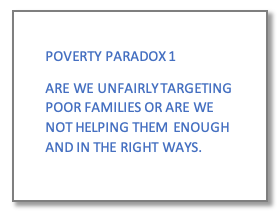
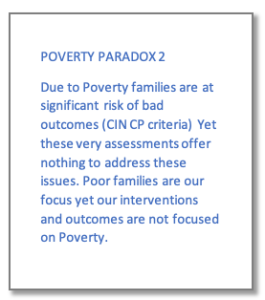
It seems after hiring the services of the Third Sector ‘007’ Josh McAllister and this week the publishing of Kingston upon Hull University’ findings we have amazingly come to the same conclusion as the first social worker 125 years ago.  The Hull report found that Children in the poorest areas are 14 times more likely to be referred to social care than children in the richest areas.  Simply, its not who your parents or family are its your postcode.

Can social work be boiled done to the simplest equation?

POVERTY = bad outcomes for children and families + Social Care intervention.

Mary’s work chronicled the lives of London’s poor in her own recording system, The Almoner’s Handbook. It highlighted poor living conditions, lack of funds to purchase quality nutritious food and a lack of social and employment opportunities.

Imagine Mary working solo in one of the biggest cities in the world, on a daily basis observing the relentless anguish caused by poverty but being powerless to change the labour market, housing, the price of alcohol or the availability of fresh fruit and vegetables.

Are we equally stuck in 2021 as social workers, merely typing up the misery of people’s lives into computers with no leverage to hack at the root causes of poverty? 

Despite being a trailblazer Mary was still a product of her time and the discrimination of the deserving and undeserving poor was evident throughout her work.

In one example she refused to assist a Lady who was found to be “gossiping in the street”, whilst another who was extremely grateful to speak to Mary received a waterbed, free GP visits, and a trip to the seaside. However, let’s not pretend as social workers we don’t find it easier to advocate for families that we have a better connection with or are in some way fond of.

Or should we ask our selves a harder question? Is sexual abuse, emotional harm and domestic violence evenly spread in households regardless of income.  For example, the middle-class professional father who enacts such violence on his wife and children and then often himself, is strangely never regarded as a social care issue.

Are there any answers?

Our Assessments

There is now an extensive evidence base in the UK around the impact of poverty including, life expectancy decline, limited healthy life expectancy, poor health outcomes for children, problematic mental health, and poor social mobility. 

Yet do we own this evidence in our assessments? Do we in our analysis place the responsibility solely on parents, when our Child Protection caseloads are often situated (the vast majority of the time) on a select few estates in our Local Authorities rather than spread equally or randomly.

To call this out I feel we need to be brave and start using sentences such as the following in our assessments,

Whilst these parents have made negative choices and are responsible for the consequences these have had on their children, the impact of poverty and poor access to mental health services and improved work prospects have had a demonstrable negative impact on this vulnerable family.

Whilst the interventions offered have improved some aspects of parenting capacity, the lack of good schooling, positive local role models and access to pro social activities are likely to play a far greater role in the long term outcomes for this family.

As Kingston upon hull (2021) have evidenced this families poor financial circumstances have increased their prospects of being involved with social care and having concerns investigated irrespective of any individual features or characteristics.

Whilst this feels a radical step, if it’s true and evidenced based, are we not duty bound in terms of our professional standards to seek to include this in our work? Or, we are just playing a professional version of the Emperor’s New Clothes fable. Or even worse are we playing Mary Stewarts game of feeling that the families we work with are somehow bad or undeserving of good outcomes.

Situated choice

Micheal Blastland’s book the Hidden Half, raises a potential area that social workers can seek to explore to offer a ladder out of the poverty trap, using the lens of escaping a life of crime.The Hidden Half discusses the Shared Beginnings, Divergent Lives study. The study offered a longitudinal investigation over a 70 year period, with the focus being on following up life outcomes for boys in borstals in the Boston area in the 1940’s.

The basic question was who continued to offend and who turned their lives around despite the bad start. The crucial question, however, was what made the difference in those that turned their back on a life of crime.

Did Mary Stewart wonder about her families that she visited, comparing the ones who did slightly better or managed to get out of the slums with the ones who lived short harsh miserable lives (as the majority did). Possibly like social work Mary never got to see the success stories as they would naturally not be in need of her services as much due to their improved lives.

Micheal Blasland points out that the team, when looking at the data, could find no statistically significant correlation between any variable (education level, zip code, marital status or type of offence).  It seemed it was just the roulette wheel of life – RED or BLACK – return to prison or a happy and long family life.

The researches were totally stuck until they started visiting the 70 year old men by physically tracking them down (no mobile numbers in the 1940’s etc). What they quickly discovered was that the men who never returned to crime each had a story about a ‘Sliding Doors’ moment when they made a clear life choice.

One example was a man returned home to his wife after a hard day at the saw mill –
“I hate this job I could make ten times back in the gang”
To which his wife replied, 
“Quit the job and I quit this marriage”
From that point on the guy stayed in work and was never arrested again.

Others talked about solemn moments where they considered joining the army and made a life changing positive decision for themselves, or hard work and chance encounters offering up opportunities that they grasped with both hands.

In short, they all recalled making life changing situated choices that set them on a different life trajectory.

To give a current example the England forward Raheem Sterling’s success can be tracked down to two situated choices. One, his mother making the decision to leave the family home in a poor and violent area of Jamaica to live in the UK when Raheem was 4 and the other when Raheem’s behaviour was unmanageable at home and a youth worker in a residential project had the idea of a football match in the local park. Should he ask Raheem, could Raheem be bothered to go to the park, are the questions that would of swirled around their heads. The rest is history, Raheem made a positive situated choice when he very easily could have refused.

So, what has this got to do with social work?

I feel the issues we address such as child abuse, alcohol abuse, domestic violence and mental health can often lead to a narrow focus which only serves to narrow the opportunities for positive change. People are never single issues solutions and interventions should not make this mistake.

I would suggest we consider this. When a case is allocated look at how many assessments have predated yours. How many times has the traditional Children Act led intervention been meted out with no or little lasting change?

For example, would the father who has been suffering from depression benefit from an engaging employment skills course or clearing his debt. Are these actions more achievable and more beneficial than a long NHS waiting list and short course of CBT?  Or would a young mother who is socially isolated and struggling with their child’s schooling not benefit from volunteering a few days a week at the child’s school.

Do our interventions open doors up to families or do they just seek to close the Child in Need or Child Protection door behind them when they scrape through our artificial risk threshold. Whilst any intervention we offer can end up in a dead end, should we not seek the ones that would maximize the potential of the individual and their families, supporting situated choices.

Crucially I am not denigrating mental health support and traditional services, I am just suggesting that if we don’t support an expanding of horizons and options for families we are doing no better than Mary Stewart visiting the same poor families to offer help that are living in conditions they have no means to escape from.

As social workers we must believe that all families are deserving of enhanced life options. We need to be willing to explore creative options and take a chance to jointly develop a map out of their current circumstance and hopefully that may create at least some lasting change.

About the writer…..

George Bull

George has been a social worker for 10 years working mainly in child protection and Early Help. He has lectured with Jamie Scorer at New College Durham, University of Sunderland and University of Northumbria in solution focused practice.

The transition problem – student to practitioner

In their book ‘The Lost Art of Running’ Shane Benzie and Tim Major talk about research that was undertaken with athletes that sought to explore their running gait and style. The research was conducted indoors on a treadmill so that the researchers could control conditions. They watched the athletes and learnt lots about how they ran and offered suggestions to improve. They runners got better at running.

They then moved outdoors and…. the improvements disappeared. The changes didn’t work the same. Because outdoors – real life if you like – isn’t the same as in the lab. The runners still used what they had learnt but had to re-engineer and, in some cases, relearn some of what they knew. Social Work is the same. What you learn at University and what you learn on placement gets you through the door and you then need to transfer that knowledge into the real world of practice.

Croisdale-Appleby noted this in the 2014 report Re-visioning Social Work Education and said ‘the first year of practice is absolutely vital for social workers as they consolidate the learning from their degree and develop new knowledge and skills in their first employment setting’

Playing the guitar

Let me give you another example. I’m a guitarist and have taught many people over the years to play the basics. If I was to hand someone a guitar they would intuitively know what to do with it…. to a point. They would know not to try and blow into it like it was a wood instrument. They would know it wasn’t something to help them with cooking. They would probably pluck the strings. I’d then teach them a little theory. Which string needs to be tuned to which note and what shapes to place your fingers in on the fret board to make chords to strum. We’d then practice. We’d replay, over and over again, the same shapes and learn to change between them. Over time we’d learn to play a song with the chords we had learnt and invariably the student says I’d like to play ‘song x’. So you look at ‘song x’ and realise that the guitar student knows most of the chords but needs the chord of F to play it all. F is not an easy chord for a beginner. They feel like they are back to square one and their confidence takes a knock. But over time (a long time) they overcome this, learn F, and a whole other set of chords, and they become proficient enough to play with other people and maybe join a band. They have to learn to then play in time with others… this is not as easy at it sounds. Then… someone might ask them to improvise a guitar solo which they’ve never done before so they use their intuition! ….based on the theory they know and the practice they have done Full circle! And the first time they do it it may well be alright but it might not be brilliant but they’ll practice and it will get better

Intuition > Theory > Practice > Time > Intuition (or as we call it Practice Wisdom)

Starting in practice

Evidence from Grant Sheridan and Webb (2017) suggests that newly qualified social workers felt ‘quite well’ or ‘very well prepared’ for practice in general. However, when this is broken down into preparedness for specific tasks, confidence levels drop. Essentially I’d suggest this is because specific tasks are often context specific (the type of social work you are doing and the organisation you are doing it in) and role specific – that is – not generic. You have to reapply the skills from the treadmill on the outdoor running track.

The conclusion of formal social work education is only one layer of the learning experience which is continuous throughout your career (or should be).

They also found that respondents felt most prepared to ‘promote and enable’ (89 per cent) and least prepared to ‘intervene and provide’ (32 per cent). Again because intervene and provide is context specific whereas promote and enable has a more value base feel about it. Respondents in the study reported feeling ready to conduct assessments, build relationships and communicate but less prepared for commissioning services and dealing with IT systems. Well they would because you can’t teach this as it is too organisation specific. They said they felt prepared for applying theory and demonstrating values but not for caseload management. It’s not the face to face work that seems to cause the stress but the ‘office’ function the research tells us.

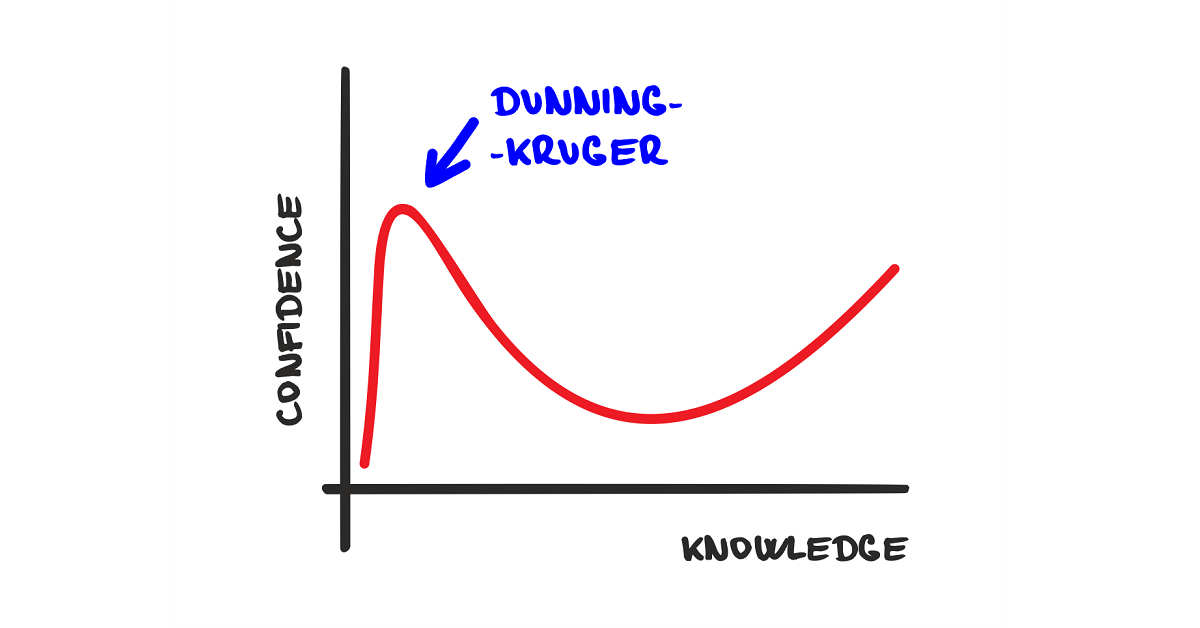
The Dunning-Kruger effect

There is also something else going on that relates to the Dunning-Kruger effect. There are certain points in our lives where we are likely to overestimate our abilities and feel quite confident. Usually when we have achieved something that has taken great effort. Like completing a degree or securing a promotion or becoming a manger… or becoming a lecturer! The problem occurs when you transition from something where you are at the top of your game and you have to translate that knowledge into something else. This transition tends to undermine your confidence and you feel like an imposter.

Objectivity's Blind-Spot: The Dunning-Kruger Effect | Procrastination.com

Moving from being a student into practice is one such transition. You’ve just graduated and you know loads of stuff. You’ve just had a great placement and a got a good mark for your dissertation and then you have to translate the knowledge you have (which is valuable) into the new practice environment. You are likely to feel immediately out of your depth and like you know nothing and your confidence will take a hit.

At this point you need to remember some things. This feeling is completely normal for us all, to one degree or another, when we transition. You do know loads of stuff you just need to rework that knowledge into a new environment – stay calm. When transitioning it’s essential to stay focussed and organised. You are going to have to ‘lean into’ this for a while and it will take pretty much all of your energy. As in the diagram above your confidence will take a hit but apply the theory, engage in practice, take your time, and you will develop the practice wisdom to climb up that curve again….. and next time you transition you are likely to have to go through the same process again! Joy!

Remember your degree can not completely prepare you. It can only give you what you need to get started. It gets you the key to the door. Like people say about driving a car. You only really learn to drive a car after you’ve passed your driving test. This is the same. You are qualified, you are good enough, you can do this… but… the transition is going to be difficult and now you know that you can prepare for it.

  • Have growth mindset, a positive attitude, and that will help.
  • Keep on top of your planning and organisation and take time out for yourself.
  • Don’t lose yourself in the transition.
  • Work with your manager and mentor in an honest way and seek out support.

Whenever things are changing those who create as much order as possible do the best.

References:

Newly Qualified Social Workers’ Readiness for Practice in Scotland Scott Grant, Lynn Sheridan and Stephen A. Webb British Journal of Social Work (2017) 47, 487–506

Croisdale-Appleby, D. (2014) Re-Visioning Social Work Education: An Independent Review, London, Department of Health

Getting to grips with theory: Transactional analysis

I honestly don’t know why but I’m a huge fan of ideas and theories that emerged in the late 50’s and 60’s. It was certainly a time when ideas about the importance of ‘self’ took hold with people like Rogers and Maslow exploring how to be our best selves – scaling the dizzy heights of self-actualisation! One such idea to come out of that same era was Transactional Analysis which is a way of examining the interactions between people.

It was developed by Eric Berne (1910-70) in the late 1950’s as a basis for understanding behavior through communication. Its origins are in groupwork where the transactions – the communication interactions – were analysed to develop understanding. It draws on a range of theoretical perspectives and considers ideas about the subconscious mind and its influence, so, is psychoanalytical. It is humanist in that sees the individual as important, and cognitive as it considers cognitive processes and seeks when necessary to attempt to adapt cognitive processes.

It can be used to explore the Individual, two person relationships and group interaction. Let’s explore its components.

Using Transactional Analysis in the Workplace - ReadyToManageStrokes

‘Strokes’ is a motivational concept where a ‘stroke’ is an act of recognition from one person to another. The communication of acceptance or ‘liking’, is referred to as positive stroking, whereas criticism and ‘discounting’ are negative stroking. There are parallels here with the concept of reinforcing in behaviorism and also ideas of affirmation and validation

Positive strokes would be things like praise, compliments, recognition, affection, rewards, sympathy, consolation, and even self-satisfaction from a job well done. Negative strokes would be put downs, criticism, ridicule, scolding, or punishment. Strokes can be ‘Conditional’ that is they relate to what you do and are not directly about you as a person – ‘you did  that task very  well’. Whereas unconditional strokes are not about what you do but are about you – ‘I really like you’. There is no condition just a statement.

Strokes can have ulterior motives where people say things to gain favor. I remember one student I taught used to say things like, ‘You’re looking good today Stephen – lovely shirt’, usually around assignment marking time!

Life positions - I'm okay, you're okay - GP-Training.netOk-ness

This idea refers to a basic attitude of acceptance towards self and others and states that people adopt one of four positions.

  • I’m Ok – You’re not Ok – this is rejection and belittling of the other. Maybe it’s ‘I don’t like you’ or ‘I don’t like what you represent’. It could be because the other person is constructively challenging and the person doesn’t like being challenged.
  • I’m Ok – You’re Ok – the preferred position – acceptance of self and others. This is the state we need to try and establish when working with people. Such a position can generate forward momentum.
  • I’m not Ok – You’re Ok – reflects avoidance of the other and maybe suggests things to be explored with the person. At least if the person thinks ‘you’re ok’ then this may give you a starting position as they may trust what you are saying.
  • I’m not Ok – You’re not Ok – Berne suggests reflects a depressive hopeless attitude to life. The question is how to create forward momentum and change in such a position.
A history of Eric Berne
Eric Berne

Ego states

Berne suggest there are three ego states – the parent, the adult, and the child. We can all, whether we are adults, parents or children adopt these ego states.

The Parent Ego state is when we adopt behaviours, thoughts and feelings copied from parents or parent figures so is a ‘taught’ ego state. The Adult Ego state is found in behaviours, thoughts and feelings which are a direct response to the here and now and are a ‘thought’ ego state. The Child Ego state is where we replay behaviours, thoughts, and feelings from childhood and is a ‘felt’ state.

Parent (“exteropsyche”): is a state in which people behave, feel, and think in response to an unconscious mimicking of how their parents (or other parental figures) acted, or how they interpreted their parent’s actions. For example, a person may shout at someone out of frustration because they witnessed that as a response, a way of being, in a parent or important person.

Adult (“neopsyche”): a state of the ego, which is very pragmatic and practical, thinking things through logically to make predictions and maybe absent of major emotions that could affect success. Learning to strengthen the Adult is a goal of Transactional Analysis. While a person is in the Adult ego state, they are directed towards an objective appraisal of reality. This resonates so much with me in terms of my writing about productivity and being organised. Developing this ego state means we can relate to people and events in a structured way. Not lacking emotions necessarily but being in control of them.

Child (“archaeopsyche”): a state in which people behave, feel and think similarly to how they did in childhood. The Child is the source of emotions, creation, recreation, spontaneity and intimacy. We need to spend some time in this state I’d argue but it needs to be carefully managed.

Transactions that are complimentary sustain and lead to smooth conversation

So, Adult to Adult could result in solving a problem, whereas Parent to Parent could lead to critical gossip (something lots of people enjoy! We are only human!). Child to Child or Parent to Child could be about playing together.

Banning Small Talk From Your Conversations Makes You Happier, Says Science  (Ask Any of These 12 Questions for a Change) | Inc.com

Crossed transactions cause communication to be broken and give us what is sometimes referred to as ‘a bumpy conversation ride’. Where the stimulus in the conversation originates in Adult and is directed to Adult but the respondent returns conversation from say Child directing it to Parent, or equally, Parent to Child, we may see a problem. I’m wanting to have a serious productive conversation, but I get a petulant child response, or a critical parent response and I’m left on the back foot not knowing quite what happened. Or indeed I’m after a bit of jovial childlike banter and I make a joke that falls flat on its face when someone responds from Adult and I’m left deflated. This happens a lot with my jokes…I need to think about that…. 😉

Within each of these ego states are subdivisions. Parental figures are often either more nurturing or more criticising. Childhood behaviours are either more natural (free) or more adapted to others. These subdivisions categorise individuals’ patterns of behaviour, feelings, and ways of thinking, that can be functional, beneficial, and positive, or dysfunctional, counterproductive, and negative.

Critical Parent can be lecturing or judging – all about what you should do or shouldn’t do. Remember this is not just ‘real’ parent to ‘real’ child – you can be ‘in’ Critical Parent in adult conversations. ‘I don’t know what you do with your time. I need the report now!’

Nurturing Parent on the other hand is sympathetic, advising, and takes care. ‘You seem to be missing deadlines can we talk about what we can maybe do to help?’

In the same problem above Adult may be objective, rational, and problem solving. ‘Let’s reach an agreement on giving you a little longer but it must be done by then. Let’s see what work we can take off you to give you time’.

The Adapted Child may then play the game (Berne loves game playing ideas) and may manipulate the situation trying to drive Adult into Nurturing Parent. ‘I’ve just found everything so hard lately’. Or maybe will be submissive and conform to Adult expectations. ‘Yes, whatever you want me to do’.

The Natural Child might be playful or impulsive and may rebel. ‘Sorry but I can’t I’m taking today off – nobody bothers about the dates things are due anyway!’

Strengths-based conversations: quick tips for practiceHow is this relevant to SW?

  • It helps us understand the other person
  • It gives us opportunity to consider how to respond in a helpful way to build rapport.
  • It helps communication by trying to shift the other persons ego state to Adult to establish an Adult to Adult conversation.
  • TA tells us you can have considerable impact on modifying behaviour by how you communicate. The Adult ego state seeks to ‘control’ the other ego states.

Using TA for effective communication

For effective communication you need to keep the transaction complementary i.e. focus on sender to receiver and receiver to sender where the message is sent to the ego state from which you expect a reply. Using ego states we can look at how others communicate and how we communicate with others.  It’s possible to identify which ego state we are in and which ego state we are expecting a reply from.

We can also use TA to help us plan transactions. For example, we can identify which ego state would be most valuable for us to send the message from and which ego state it would be better for it to be received by. If we receive a reply from the wrong (non expected) ego state then we can either try to shift the other person’s ego state or if we cannot do this it may be better to stop the communication and try again another time when the person may be in a different ego state.

We can listen to people’s communication to identify if they are habitually in one ego state and then decide if communication to that ego state would be appropriate or not. TA therefore can be used to elicit the reactions you want from other people (and this will happen consciously or unconsciously).  We are trying to achieve Adult to Adult

We can help communication if we need to by trying to shift the other person’s ego state by inviting people to move into a different ego state. They may not always move into it though, particularly if someone is habitually in one ego state. Do this by acknowledging their current ego state (by the appropriate message or response) and then invite them into another ego state by the words (and body language) which you use.

Transactional Analysis implies that you can have considerable impact by the way you communicate with others.

You can use your Adult ego state to think about what behaviour is appropriate and then engage in that way to facilitate helpful conversations. 

Invisible: Two Presidents, Catwoman and Social Work Reviews

Last month the government announced a wide scoping investigation into childrens’ social work and the care system with Frontline boss Josh MacAlister appointed as the head honcho.

Josh is a rising star of private sector social work, he’s the brainchild of Frontline a programme that seeks to fast track top students hopefully from Universities that have rowing and lacrosse teams to be social workers putting the profession on an even footing with legal careers. It offers a short 5-week intensive summer school before entering practice and placement, with a clear trajectory of management and beyond. Why should social work not get the best and smartest kids from University is the rhetorical question it seems? For nearly ten years he has received funding and been a go to man for the conservative government, in short, he is the archetypical Govian innovator (Michael Gove himself in the care system for 4 months as a child).

Enter Catwoman

I hate to bore you all with yet another Catwoman and social work story, but I think there is a surprising link found in the biography of Ertha Kitt.

Ertha was born in 1927 on a cotton planation as a consequence of a rape by a white doctor. Her mother (who was half African American and half Cherokee) was forced to give Ertha up to another family as her then new partner could not abide her “yellow” mixed race skin. Her new family raped and abused her and set her to work as a slave in their home leaving her to be tormented by their own children. Her route to stardom is one of the most remarkable stories in modern American history.

The indefatigable Ertha became a sultry actor (batman, mission impossible, Disney, Miami Vice), singer (Santa Baby) and performer (too many stage plays to mention). One of many big breaks came when she got a once in a lifetime role as Catwoman in the ultra kitch 60’s Batman TV series! KAPOW!!!!. 

During this time Orson Wells described her as “the most exciting women in world” 

50 years before The Black Panther movie one year before MLK got assassinated there was Eartha holding a gun to the head of the Joker, seducing Batman and generally stealing every single scene. Catwoman’s role would be to upset the status quo make villain and hero feel uneasy and unsure about what they have previously assumed and the positions they occupied.

During this exact period President Johnson’s wife, the extraordinarily named Ladybird Johnson, held a meeting at the White House to discuss why the youth of America had become so disaffected. There was rising crime, broken homes, drugs and gangs, all of which were major concerns. All this set against the disastrous Vietnam War Johnson had started, a war that was a bad idea executed badly that costs millions of lives.

To crack the problem Ladybird assembled a white crowd of socially clambering Stepford Wives and to quietly sit in the corner and to provide ‘faux’ racial balance, Eartha. With the pristinely ironed and noxiously perfumed beige mob assembled, speaker after speaker, talked about the tidy highways, excellent school system and really nothing to do with disaffected youth let alone any offer any solutions. Towards the end Eartha raised her hand and summed up the mood for the youth of America thus,

“Boys I know across the nation feel it doesn’t pay to be a good guy,”. “They figure with a record they don’t have to go off to Vietnam. You send the best of this country off to be shot and maimed”.

Hearing this Ladybird Johnson bursts into tears and was furious with Eartha. A little later her husband the president walks in and Eartha again unprompted starts questioning him about the war, motherhood and the root of the problem. The body language in the picture below explains how he responded to her.

TRUTH TO POWER!!!!!

Eartha did not care one jot for upsetting the room or the ultimate decision maker the president, she cared more for the children than her own standing.  Her reward for upsetting Ladybird and the president was the CIA basically shut her career down with her not working for over 15 years in the US again.

I am 10000% confident the review by Mr MacAlister will not dim his lights in the hearts of the senior Tories or his bank balance, he will not risk his career one jot so his suggestions will be palatable to his pay masters.

However is Eartha’s position a foolish one to occupy. The economist in me would suggest an outcome that optimizes the probability of something being accepted or achieved and the impact of the expected outcome, even if your right implementation is important. What value in making a suggestion that you know will never be put in place, or if it is watered down. For example Munro’s review (as she acknowledges) got universal nods of approval but little policy or actual change.

The Trade off being

MacAlister – High chance of acceptance + Low potential impact
v.
Ertha – Low chance of acceptance  + High potential Impact

Tony Robbins

Another maverick who spoke to a president is the I Am Not Your Guru documentary maker and motivational zillionaire Tony Robbins. He was invited with another group of the politically harmless to speak with Obama in early 2014 about his health care bill.

Whilst Tony agreed with Obama’s policies, he made a point that stunned the room. Tony explained to the president that the error that he is making is that his policy on issues such as health care are based primarily on Obama being the smart and him feeling his policies are the best ones, however for policy to work this is simply not enough. It’s about relationships and if you don’t take the other half of America with you and your party will pay a price (and look how that turned out insert Trump MAGA emoji here).

The message here is even if you have a good, or even the best idea it has to be gripped and accepted by the populous for its implementation to be successful. Johnson and Obama could not be further apart politically, but they fell on the same trap that is looming over MacAlister’s Review. The first sign of this came when MacAlister jettisoned many voices and tarnished thousands of potential relationships with the people he seeks to aid, namely care leavers and other stakeholders. 1000 care experienced people applied, 40 were successful of which about 10-15 will form part of the review board.  (You stand a better chance getting into Oxford or Cambridge with this offering a poignant Irony to the type of student McAllister wants to have on his Frontline programme.)

Imagine for a second a care leaver whose life story is a series of assessments, letters, and case notes on a computer, being asked to help but just getting another generic “no thanks” response to your ideas.

Ex piano tuner Alison Moyet I feel comes close to an accurate description in her 80’s hit Invisible,

You’ve got me so confused and there’s words I could use
But I’m afraid to say them
I feel I’ve been had and I’m boiling mad

You don’t have the time and you won’t spend a dime
Not even to call me
You don’t know I exist and I wouldn’t be missed
If I had the nerve to quit you

Invisible – I feel like I’m invisible
You treat me like I’m not really there
And you don’t really care

I wonder if Josh Mccalister is a Moyet fan?

Earlier this month I attended a conference that Mr Mcallister spoke at concerning Connected/Kinship Care.

At one point an experienced Carer/advocate raised the issue of several disparities between work/leave entitlement between kinship care and adoption and the post code lottery of levels of support and financial assistance to carers. MacAlister responded that he will look into theses issues and address them were possible. His unique cocktail of suave confident good looks, positivity and engagement really convinced me and likely many others in the conference. He on the face of it did better than Obama and Johnson.

However, after a day’s contemplation I realised the scale of ironing out these inequalities in just one small corner (kinship care) of his vast review. The following would have to be re-aligned.

  • Employment law, The Paternity and Adoption Leave Regulations 2002
  • Children (leaving Care Act) 2002
  • SGO support regulation
  • Local Authority financing

The scale of this task is tremendous and the votes in parliaments, debates and implementation would need to go on for many years beyond the publishing of Mr MacAlister’s review. Potentially Mr MacAlister is naive, and we can’t expect him to know the ins and outs of every area, but each of his recommendations I feel should be separated between easy wins and herculean legislative labours. Any one can provide a wish list, the real magic is in high quality and lasting implementation.

I wish MacAlister all the best with his review, but would urge him to be the Eartha and Tony Robbins in the room and don’t fall into Obama and Johnsons trap in leaving the Invisible people behind just because you think you’re the smartest.

Links

Munro’s review

Frontline website

Moyet singing

Eartha Kitt meets president

Solution Focused Gorillas

In 2006 Cadburys poisoned 37 people with Salmonella and the treasured British company was brought to it knees. Fined millions, reputation in the trash, hostile take over talk, how could it ever recover…………….

Cadbury’s response was marketing genius they ran one of the most famous adverts of the past twenty years.

[You really should watch it (below) –  it’s amazing! It’s 4 and half minutes long (this link is a shorter version – but if you have the time watch the long one – it is sooooo worth it!]


The advert features no humans (Phil Collins excepted) and no chocolate, it just creates a warm positive enjoyable feeling exactly the feeling that Cadburys wants associated to their brand.

By honing down to base psychology Cadburys have distanced themselves from their Salmonella existential crisis.  The advert was entirely positive, feel good and very importantly simple. Cadburys chocolate will make you feel like the advert does.

The next video….. well…. watch it then I’ll tell you….


It features the very same gorilla as in the Cadbury advert (honest!) in the now famous experiment by Simon and Chabris (2009). In the experiment the focus of the viewer is requested to be entirely on the white team passing the ball, the human brain squarely focuses on its target to the deletion of everything else.

Nearly all test subjects fail to spot the gorilla but can count accurately the number of passes of the ball, as soon as you are told of the gorilla it is 100% obvious, as gorillas always are.

Before the gorilla starred in adverts and experiments, he used to live in the jungle where he met famous primatologist (monkey expert) Diane Fosse.

The male gorilla before Fosse (and others Sigourney Weaver etc) had always been considered to be totally dominant in sexual situations with the female subservient and vulnerable.

As Matthew Syed points out in his excellent Rebel Ideas (2019) however, primatology was full of stuffy bearded men in the Charles Darwin mould who had a massive blind spot about female activity. They accepted the dominant view and importantly had no interest in challenging it creating a jaundiced perceived wisdom. Syed observes that it was not until a critical mass of female scientists entered the field that the frame of reference shifted and female gorillas were found to have agency and power, and, could select a range of sexual partners.

The story of this gorilla I feel is useful to solution focused work as it makes clear a very important point.

“You see what you aim at”

This quote by, at times controversial, psychologist Jordan Peterson I feel holds a lot of weight for social care. The power, and indeed ‘blindness’, that can be achieved by a clear focus is both useful and dangerous.

Here are some examples –

The social worker whose main focus is the assessment rather than supporting lasting and client led change, or the family whose only focus is to seek the end to the intervention never questioning or considering possible future directions or opportunities.

Conversely the focus on one particular issue for a period of time can yield results as nobody can deal with many problems all at the same time (I’m sure many of us have all been to child protection or adult safeguarding meetings where the list of identified issues is long).

To balance this I feel as social workers we need a wide lens to be open to risky ideas that will reverse challenging situations (Cadburys),  we must be brave not to fall under the cloak of perceived and dominant thinking (Dianne Fosse) and to be focused on the detail but not to miss the gorilla in the room (Simon and Chabris).

George Bull

George is a Social Worker at the Connected Carers Team South Tyneside. He has been a social worker for 10 years working mainly in child protection and Early Help. He has lectured with Jamie Scorer at New College Durham, University of Sunderland and University of Northumbria in solution focused practice.

References:

Simon and Chabris (2009) https://journals.sagepub.com/doi/10.1068/p281059

Rebel Ideas, Syed (2019) https://www.amazon.co.uk/Rebel-Ideas-Power-Diverse-Thinking/dp/1473613914