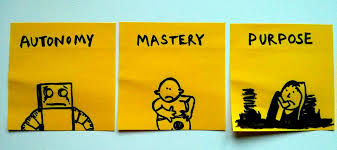
Autonomy – one of the keys to success

I talk to people a lot about ‘flow’. This is a concept that I first came across in the landmark book ‘Flow’ by Mihaly Csikszentmihalyi. Flow is essentially the state that you can find yourself in when you are totally absorbed in something to exclusion of all other things. A mindful state if you like. You have the skills and knowledge to me master of what ever you are doing and you are engaging in it purposefully. Crucially alongside those elements in generating flow is autonomy.

Autonomy is the ability to make your own decisions and exercise control over the tasks that you have to engage in. Now, this can be difficult as in paid employment our tasks are given to us, often by a manager. So, how do we engage autonomously and create flow there.

Well, even though our tasks are often set out for us they are almost always set out as an end goal. We can often, particularly in professional practice, exercise autonomy in how we get to the end result. We can also be in control of how we break the task up and when we set time aside to do it.

In the midst of a world that often seems outside of our control if we control the bits we can control we will generate more flow. You can’t control what is given to you to do, you can’t control how people act towards you, but you can control how you respond. The more in control you feel of things in general in your life the more likely you are to respond from a place of control.

Take the tasks you have been given and control them. As David Allen, author of “Getting things done: The art of stress free productivity”, says, “if you don’t control it, it will control you.” So, take the task. Figure out the end goal and usually the end date. Then break the task down into the manageable chunks that will get you to the end goal. This method works well for tasks that have both a long and a short time frame.

Where a task has a short time frame – the “I need it by this afternoon” tasks – people tend to jump straight in in a state of panic and just start doing. You must stop and take stock and plan how to get to the end even when the end is only a few hours a way ….And still diary the tasks. Writing things down helps consolidate them. I find that it also helps you spot flaws in your strategy to get to the end point because the act of writing things down slows you down and allows your deliberate brain to take charge of your automatic brain. ‘You can’t plan and do at the same time’, as Allen also says. So plan it then simply execute your plan.

The method also works with long terms tasks for one key reason. If all you set out in your head or diary is what the end task looks like and when the end date is you are more prone to procrastination. If you set the end point and dairy in all the steps so that you can chip away at the task a step at a time you are more likely to do those little steps when you hit them in your dairy than you are if all you have to think about is the big task. The thought of the big task will sap your psychological energy to the point you don’t make a start. And, as we know, “making a start is the hardest part!” It’s easier to make a start on a small task. So, a bigger task, broken down into lots of smaller tasks, is easier to get going on. If your a last minuter… take note! You all know who you are 🙂

In whatever you do find what you have control over and be autonomous in how you think about those elements.

Get your flow on!

Where’s your ‘self’?

I am, it seems, mildly obsessed with the idea of ‘self’. I just think who we are is so important. Often our public selves and private selves lack the connection that I feel is so important to well-being. When you are at odds with yourself, that is, you have to present yourself in a way that doesn’t match how you are, or how you are feeling, then you hit problems. We have to be authentic.

I’m reading ‘Ice’ by Anna Kavan and while my interpretation of what I’m reading doesn’t match what I’ve read about the novel (isn’t that the point of art to put your own interpretation on it?) I feel what I’m struck by resonates with the narrative undercurrent. The man in the novel is searching for a woman who keeps alluding him. It feels like the author is talking about searching and, for me, it feels more specifically searching for oneself. Our identity, our self, I feel, often alludes us. We are often frustrated when trying to find who we are. Just as we feel we are grasping who we are we somehow escape ourselves.

Cicero (Philosopher in the Stoic tradition 107-44 BCE) suggests that people’s sense of self, their sense of who they are, is created by being free to choose – autonomous, and therefore making their own decisions. He also suggested that the human community is the bond between people. The people we are connected to somehow helps us construct our sense of self. How people perceive us and how they interact with us gives us a sense of who we are. This seems to show that how we are constructed has an internal and external dimension. Indeed, I’d suggest I am not the man I was 20 years ago, 5 years ago, a year ago, or even yesterday. We are constantly being reformed and shaped.

In reflecting on my own ‘self’ I started by thinking that I am more consolidated in my sense of who I am at this point in my life – my public and private selves occupy a very similar space. I am not much different at work than at home for example. This gives me a feeling of settledness. An authenticity. I don’t think though this is because of chronological age. “I am older therefore I understand myself better.” I think it is simply that I do understand myself better. I could have arrived at this point at age 24, or 42, or now, or indeed never. Sadly I fear that ‘never’ may be the reality for many people. They never discover who they are, they never discover their ‘self’.

The reality is that the discovery of self is a multifaceted journey. Not only is it a spiritual one – a discovery of your inner-self, but also a discovery of your physical self, your emotional self, and your mental self (which I think is different to your spiritual self). Your ‘self’ is constructed from all of these things. You only discover who you are from testing yourself in all of these areas to a point where you can conclude ‘that is me’.

For me, discovering your ‘self’ is often about discovering both your talents and limitations. We are all good at some things and we are all limited in certain areas. Knowing what these things are and knowing where your ‘lines in the sand’ are is the secret to an understanding of self. Such knowledge comes from self reflection.

Self reflection should lead us to understand our strengths and limitations in terms of our physical self, emotional self and mental self. Such knowledge leads to us knowing where to expend our energies, what our talents are if you like – Where we can make our contribution. Doing things well builds our self esteem – this is good for our wellbeing. As Cicero points out our internal self is important – our sense of autonomy, of being in control. He also notes the importance of how we connect in building our ‘self’. Making a contribution individually and collectively builds our sense of who we are. We need to engage with an internal process and connect externally.

My advice with regard to reflection is to spend time in quiet. Meditate. Record what you are thinking in a journal. Every so often read over what you have written and think about your journey. Think about who you are. Enquire upon your ‘self’ Don’t let ‘you’ allude ‘you’. Knowing oneself I feel leads to peace.

Amazing!

I tend to start from a position of scepticism. It stops me spending money on shiny things and new-fangled things that I spot in adverts. Despite desperately trying to avoid the latest fad for this or that I’m often sucked in. So when adverts for Shakti mats kept appearing in my facebook feed I looked and then looked away. But, they kept appearing and I kept being intrigued. So I did a bit of research and decided there was enough of a groundswell of opinion from a range of sources that this was a good thing that I thought, ‘let’s give it a go!’

The Shatki Mat

The Shakti mat is a spikey affair! With some 6000 spikes in the form of little plastic disks attached to a mat. You lie on it! Yes! Lie on it – all 6000 little spikes digging into your back. The mat is about torso length so stretches from the small of the back to the nape of your neck. It works, so the adverts say, by stimulating acupressure points resulting in the release of endorphins and a range of other calming hormones.

Now, you know me, I think about and write about stress and how to overcome it. I’m a big fan of meditation and mindfulness and a big fan of giving things a try! So this seemed right up my street. I’m also not very good at meditation. My mind wanders off at the drop of a hat and I have to refocus. From what I was reading I thought this might be a good opportunity to feel overwhelmed by something to the effect that I cleared my mind.

6000 spikes!

The advice was to lay it on the floor or bed. I went for bed as I thought it would be a bit more comfortable. You then lie down on it and stay there for anything up to 20 minutes. I’m not going to lie, as reported in some of the blogs I read, when you first lie on it, it bloody hurts! But, then, as the blogs went on to say, after about 3 or 4 minutes the pain subsides and you get a wonderful warm sensation across your back. This is exactly what happened!

The feeling, I find, is quite euphoric. You have to steal yourself for the first few minutes but once through that the feeling is wonderful. I’m not being paid to say this. I bought my own mat. I’d tell you if I thought it was rubbish and not worth enduring those first few painful minutes.

Here’s the other thing! It has really improved my meditation. I stick my mediation music on, light an incense stick, and drift off. What I think is happening and what helps is that the pain takes some bearing, so, when you first lie on it you can’t think of much else other than the fact there are 6000 spikes sticking in your back! By the time this subsides you have removed all other thoughts from your mind. The discomfort distracts you from thinking about anything else, switching off invasive thoughts. It works for me!

It’s reported in various places that the mat can reduce stress and anxiety and help with muscle pain. Here’s what I think is going on. Resilience to stress is multi-faceted. One aspect is physical resilience which I feel is related to mental resilience. There is plenty of research that talks about the mind-body loop. We know that good physical health can lead to good mental health and vice versa. When you lie down on the mat your stress response is activated. You are causing yourself pain. You are physically stressing your body. This will initiate your bodies stress response which is the release of cortisol and adrenaline. The act of lying on the mat and learning how to maintain calm while experiencing the discomfort and waiting for it to subside ‘teaches’ your body and your mind how to manage your stress response. We already know that those who practice mindfulness can ‘train’ themselves to respond less emotionally and in a more balanced way to stressors and this mat I feel helps us learn to control such response.

Detail from the back of the mat

I can’t recommend the Shatki Mat enough! I was cynical but I am absolutely convinced. Not a little bit convinced! A lot convinced!

Give it a go…. you’ll be surprised …and you might be amazed!

I bought mine from here

It takes longer than you think…

Turns out writing a book takes longer than you think and takes up more time than you could ever imagine!

I’ve recently finished writing a book with Lisa Watson and Steph Hunter and it’s been wonderful experience to get my words onto paper ‘long form’. I love writing blogs that are quick to read but for anyone who enjoys writing then writing a book has to be something on your things to do list! So the book “How to Thrive in Professional Practice: A Self Care Handbook” will be out in the spring – in early May! Now that’s exciting! Available now to preorder. We talk about stress and burn out in social work and the context in which social work takes place because we’re all social workers but, to be honest, social work barely gets a mention in a lot of chapters. So it won’t matter what profession you are from what we are talking about will resonate. The reality is that all professional practice is blighted by the same problems these days. Too much to do, too little time, too few people to do it.

That means that people short change themselves by not prioritising their self-care. In professional practice and, to be honest, in all walks of life, self care is a necessity not a luxury.

So here’s the ironic thing! While writing the book on self-care my own self care took a bit of a nose dive! This means I can completely relate to people when they say, “But I don’t have time to go for a run / meditate/ eat well [delete as applicable or add your own!!]”. I didn’t lose the thread completely. My nutrition wasn’t too bad, I still did some yoga and meditation (but not a lot), and I still managed to run at least once a week.

But you see, this is the point with the model of self-care that I endorse. Life does come with its ups and downs. Your available time comes and goes. Your motivation waxes and wanes. But, if you know the golden rules you know where to get back to when you’ve ended up in the undergrowth. You won’t have completely ‘got lost’ along the way. You’ll have still done some things because once you create habits the are difficult to completely break free from. Good ones and bad ones.

Image result for writing a book

So if you find you’ve lost your way a little, don’t sweat it. We all do. Make those small changes, step by step, that I talked about in the last blog and get yourself back on track. Don’t set your goals too high but do set them.

Here’s mine for the coming weeks:
Have more nights per week with no alcohol than nights I have alcohol (because I do like a glass of red)
Run twice a week (I already do parkrun every week so that’s just one more)
Cycle once a week
Meditate for 5 minutes a day
Drink more water
Eat exactly what I’ve been eating but smaller portion sizes

Doable? I think so!
You on board
2020 is going to be great!

You can preorder the book at the following link
How to Thrive in Professional Practice

How to Thrive in Professional Practice

Game plan!

Image result for rugby world cup 2019

One of the commentators said, after the terrific England win over New Zealand in the Rugby World Cup Semi-Final (Saturday 26th October) “Game plan executed to perfection”. This comment and some other things about the game tell us a lot about being productive and getting results.

Firstly, like the commentator said, they had a plan, and once they had a plan they got on an executed their plan. No doubt they adjusted it here and there as they played but they had a plan. To be productive you must have a plan. David Allen, productivity guru, says you can’t plan and do at the same time. The England team didn’t take the field thinking “tell you what, we’ll just work it out as we go”. No they figured it out before hand. Figured out what they were up against. Figured out what to do about it. And then did.

Figure out what you need to do.
Plan how to do it.
Then, and only then, do it.

Image result for fail to plan plan to fail

Mihaly Csikszentmihalyi classic book ‘Flow’ develops the idea of being in the moment to the exclusion of all other things. Being prepared and focussed on the environment you are in and the job at hand so that you do your best work. In Drive by Daniel Pink, Pink builds on this idea talking about the key components that promote flow.

Mastery
You have to be a master of what you are doing. The England team are among the best rugby players in the world. They are masters. And you will be a master (or developing master at least) of what you do. Learning about, reading about, and engaging in what you do will create mastery. Immerse yourself in the knowledge in your field.

Autonomy – each player on the pitch was acting as an individual making their own decisions about whether to pass, or kick, or tackle. They are part of a team and they have the interest of the team at heart but they act with autonomy. You may work in a role where you feel you don’t have much decision making autonomy but you do have autonomy over how you work, how you structure your tasks, and your day. Figure out the autonomy you have and work with it. With autonomy comes responsibility. Responsibility to be organised and ready to do your job to the best of your ability. Just like the rugby players.

Purpose –
What drives you? What motivates you? For the rugby players it’s winning the game, playing well for the team. For you it may well be doing a good job. It equally could be getting organised to get stuff done so that you can leave on time to spend time with your family. What we know is things like that – motivation that comes from within – is much more effective at motivating you than external, top down, motivation – for example just doing it because the boss told you, or working to a deadline. What motivates you from inside? Figure that out and you will be more motivated because you will have purpose.

Connectedness –
You need to be connected to whatever you need to be connected to in oder to make things work. You will probably need to be connected to others. This is good for you. Working together, having others support you with what you need, and supporting others is all good for productivity and well-being. But also you need to be connected to your environment. Aware of everything yet focussed exclusively on the one thing you are doing now. The rugby players were focussed in the moment on a single task. Getting into position, passing he ball, forming the scrum. But with an awareness of the bigger picture. What was the game plan? What was the next move? What were the options? Connected to the big picture but being productive in the individual moment is essential to productivity.

So get your Game Plan on –
Get Organised –
Plan it and then do it


Water, water, everywhere.

You’ve probably heard this before…. Up to 60% of the human adult body is water. The brain and heart are composed of 73% water, and the lungs are about 83% water. The skin contains 64% water, muscles and kidneys are 79% water. Even your ‘solid’ bones are 31% water.

I’m watching the Rugby and the England manager Eddie Jones is sipping on his water and I say to Christine ‘what’s he drinking for he’s not done anything to break sweat’. Then I got to thinking – I suppose being England manager in such circumstances is quite stressful. I wonder what the relationship between hydration and stress is?

Turns out there is a two way relationship. Being dehydrated can cause an

Image result for drink water

increase in cortisol levels. Cortisol is the stress hormone present when we’re feeling the pressure and too much of it coursing through our bodies is not a good thing. It makes sense really as being dehydrated is putting your body under physical stress and stress is multi-faceted – physical, emotional, mental.

You are also more likely to become dehydrated when stressed because of elevated heart rate and heavier breathing. So it’s a vicious cycle. Dehydration leads to stress and stress leads to dehydration.

So how much water should you drink? The NHS recommend drinking 1.2 litres per day while other advice suggests nearly 2 litres. The difference, it is suggested, is due to our climate not being as warm as others. However you’ll need to increase the 1.2 litres if you live and work in a warm environment and are taking exercise. You also need to take into account your size and weight.

Image result for drink water

My suggestion is drink little and often until you find your level. After all we are all different. The colour of your urine can be a good indicator. It should be light yellow, almost clear. It’s useful to start the day with a glass of water and end the day with one. Always drink during and after exercise. And remember even just sat at your desk can be dehydrating you, given its relationship with stress.

Stay well!

Small steps end in big results

Image result for exercise

What’s your relationship like with exercise at the minute? What historically has exercise meant to you? What exercise did you do in the last week?

I used to find that how I felt about exercise was rooted in how I felt about it as a teenager. With my only reference point being PE at school. Cold cross country runs and feelings of inadequacy. The secret is not to compare yourself to others – do what you can and what you feel comfortable with. And crucially – find something you actually enjoy! There will be something out there!

You might well find that you already do more exercise than you think. Low level stuff like gardening, washing the car, walking the dog and pegging the washing out. These are all good things. They involve activity and they involve stretching – both great things. Maybe we need you to push it a little further and get a little breathless? The recommendation of 20 minutes per day still holds good – so we are not talking about hours in the gym or becoming a marathon runner – fine as those things are if they are right for you.

Exercise is a pleasurable activity… honest. Engaging in it releases

Image result for exercise

dopamine – the body’s feel good hormone. Dopamine deficiency is shown to have links to depression so the more of it you have coursing around your body the better. Exercise is also great at mitigating against the effects of stress by ‘using up’ cortisol and adrenaline that are produced by our fight or flight response. These chemicals prime you for physical action but when the stressful event is occurring with you sat at your desk you don’t burn them off. And too much of them has a negative effect on your health and overall well-being.

Image result for exercise

Exercise:
Gives you faster processing
Gives you faster reaction times
Clears you head
Makes you more effective at planning
Gives you better short term memory performance
Gives you more self control

A study by Bristol University found that a 20 minute walk at lunch time could enhance mood and motivation by 41% and could improve the ability to deal with stress by 20%. A Sit Less Move More program evaluated by Pulg-Ribera and colleagues in 2017 noted improvements in staff retention in the work place, less sickness, more mindful work, and a reduction in stress. Now that’s good stuff!

Image result for exercise

So….
Make a plan! What are you going to do and when are you going to do it?
Start small and take incremental steps… start with a 10 minute walk and take it from there.
Write down your plan… writing things down enhances the chances of them actually happening.
Exercise with someone else – it helps motivation.
Tell other people what you’re doing… there’s evidence if we ‘go public’ we’re more likely to do what you say.
And most importantly find something you enjoy
And Just Do It (as Nike would say!)

I have to tell you speak to your doctor if you have any health conditions or haven’t exercised for a long time! I’m not a doctor! Take advice if you feel you need to. This advice is given in good faith based on my own personal experience and reading. Take care.

Making a start is the hardest part…

I’ve had a job to do for weeks. A report to write. I need to have it done for a meeting tomorrow. And I’ve kept putting it off! Why!? Once I got down to it I actually enjoyed writing it and it took me about an hour an a half… that was all… and now it’s done and I feel great!

Caroline Webb in her great, highly recommended book, How to Have a Good Day, says that most of the jobs we avoid are ones that have a long term benefit. This report I had to write had no short term benefit in doing it a few weeks back but now, given the meeting is tomorrow (!) it does have a short term benefit. This, Webb tells us, is an evolutionary mechanism that sees the trade off between short term and long term benefits lead to procrastination. She says “it’s easier for our brains to assess the known present than to consider the unknown future” (pg. 104) so we tend to give more priority to the here and now than to the future.

The problem with this is that it means things get left until the last minute. What if something had happened this morning that meant I couldn’t write the report. I’d have either had to stay up late (never the time to do your best work) or look unprofessional tomorrow. I say to my adult children that there are 3 things that get you to where you need to be – the first two you will recognise – inspiration and perspiration. But there’s a third – reputation – particularly in professional work where people expect you to ‘show up’ ready to go. Don’t let yourself down by not leaving enough time to get the job done so you are prepared.

Picturing the benefits, Webb goes on to say, is the way to beat procrastination. For me, in this example, the benefit would have been a job done, ticked off my list, and not waking up every day for the last week or so thinking I must do that report. What we know is having ‘open loops’, as David Allen (The Getting Things Done Methodology) calls them erodes your psychological capital. An open loop is a thing that goes round and round in your brain that gets in the way of focussing on the task in hand. So by not doing the report I have a constant nagging ‘you need to do that report’ going around in my head when I should be applying my psychological capacity to other things! This is downside of inaction.

What is useful for some larger tasks is to break them down into smaller tasks. So with regard to the report I needed to write. I needed to find the document on line and appraise what I needed to do. I needed to read some evidence that I needed to be aware of to write the report, and then I needed to write the report. A concept called “The Power of Small Wins” tells me that if I’d broken it down into steps a few things happen. The first step suddenly seems more manageable than the whole task and then when each step is completed you get a psychological buzz of satisfaction. If you leave it as one big task you only get the buzz when the task is finished. Psychological boosts at the end of each step motivate you to move onto the next step.

Easy!

  • So, break the task down into small steps and diary them all.
  • By putting them all in your diary you remove them from your brain – so they are no longer an ‘open loop’. You will get to the step in your dairy and be reminded of what to do – you don’t need to remember what to do when.
  • Plan a ‘pay-off’. If it’s something you really are struggling to get on with plan a treat when it’s done, or a little treat when each step gets done. Treats are good!
  • Consider the downside of not taking action – this may well motivate you.
  • Remember – we often overestimate how long something is going to take. I set aside 3 hours to write the report (it had turned into a monster in my head) and it actually only took an hour and a half! I suddenly had some free time… so I wrote this blog!

Two things done when I thought I’d only get one done!
Now that’s productivity!

Sounds a bit scary!

If, like me and lots of others I talk to, the idea of meditation sounds a bit scary and unachievable… worry not… it is a difficult business. “Just sit there, on the floor, cross legged, in your linen garb, and clear your mind… think of nothing” ……of course this is one version of meditation that we could maybe strive for. But don’t be put off if you want to sit in a chair, wear your scruffy joggers, and find that after 20 seconds of clearing your mind your wondering what’s for dinner!

Keep persevering though as it has benefits for your mental health, psychological welfare and productivity that you need to tap into. Meditation, or its less scary cousin mindfulness, has been shown to actually change your brain structure. In drawing together literature on mindfulness Jacky Thomas of California State University found an amazing array of benefits from engaging in the activity. She found that it fosters self-awareness and regulates thoughts and feelings. It activates feelings of kindness and empathy, providing interpersonal attunement. It develops ‘presence’ and promotes more skilful emotional responses to people. These things have been shown to improve personal performance as well as enhancing the performance of teams through the development of feelings of safety.

I love a meme that a friend showed me that said something like “you should spend 20 minutes a day in meditation, unless you are really busy, when you should spend an hour”. This slightly tongue in cheek statement has resonance. The more you have to do the more you have to psychologically ready for the doing. And meditation and mindfulness, I feel, are on a continuum.

You can sit and attempt to clear your mind of everything for half an hour. You will probably fail! But if you want to meditate this way then accept that you may not succeed in clearing your mind. But each time you notice your mind wandering return yourself to focus on your breathing and try to clear your mind again. Despite my negative assertion at the start of the paragraph you will get better with time.

Or try mindfulness. For me (and there are various interpretations) it is about focussing on the moment you are in. So, I love a mindful walk with the dog when I simply focus on the environment around me, focus on what the dog is up to, and simply delight in what I see. I do this while deep breathing – especially when I’m walking across the fields adjacent to my house, breathing in the fresh air and visually absorbing nature – wonderful!

My favourite and most effective exercise is the shortest one I do. If I feel myself getting wound up or anxious about something, or in the moments before I deliver a lecture, I stop my mind, apply the breaks, breathe in for a count of three, hold that breath for three, and breath out for three. I repeat maybe 3 or 4 times…. and the feeling borders on magical!

Try it now and feel the wave of calm!

Have a good day!

Discipline! Let’s get to work!

Last night felt like a watershed moment in some ways. Although as with most things about self care these moments are simply reminders of things we already know either instinctively or because we’ve been told them and are choosing to ignore our knowledge.

I was reading Daily Self Discipline by Martin Meadows and he said simply that succeeding in anything is about discipline. And I thought – you are so right! Think about sports men and women. We often fall into the trap of thinking that people are just naturally talented – and there is an element of that. Some people have the physiology or the genetics that maybe gives them a leg up. But none of the great sports people have got to where they are without sheer hard work born out of discipline. In Mindset, Carol Dweck, talks about having a growth mindset rather than a fixed mindset. The person with a fixed mindset says – this is the life I have been dealt and nothing I do will change it. The person with the growth mindset says by diligent hard work, exploration, education, and discipline I can achieve anything. And this is true! She talks about a conversation with tennis superstar John McEnroe who explained that he had a fixed mindset and that he feels, looking back, that this led to his on court tantrums and antics. He felt he was gifted and had a right to win simply because he was John McEnroe. He skipped training, didn’t focus, because he felt he would win no matter what because he had ‘it’ and others didn’t. He feels he would have been even better, making more of what he had been given, if he had a growth mindset.

We can achieve a great deal with discipline. The other example would be eating a healthy diet. It is so easy to give into temptation and can feel so hard to prepare food in advance to take to work or make the healthy choice. But if we do this we will feel more positive and more in control. I know that my healthy choices slip when something is going on that I don’t have control over. It’s then a vicious cycle. I eat something unhealthy or I have a few glasses of wine on a night, and before I know where I’m at my diet has shifted away from my usual healthy eating and a measures approach to being negative in terms of my well-being.

Discipline is easier when you have a plan and integrate things into your routine. I was thinking of all of the positives of my morning walk with the dog. I use it as a kind of meditation, more like mindfulness really. I love just watching the dog being a dog. She loves just doing what dogs should do – without a care in the world. The morning walk with the dog (or without for that matter) has lots of self care pluses! Here they are:

Being outdoors is good for beating stress
Being outdoors in the early morning sunlight primes the process for sleep at the end of the day
Walking for 30 minutes beats stress and means you’ve already had some great physical exercise without barely trying
Walking mindfully, and deep breathing, is good for you. Research with social workers who engaged in mindfulness showed a reduction in sickness and stress levels…. suck in that fresh air!

But, it takes discipline to get out of bed early enough to do this and to undertake the walk without cutting it short or rushing it. Here’s the rub when it comes to discipline. You will feel better if you focus and get things done. Be that walking the dog, or getting that report written, or saving a little money every month, or preparing healthy food to take to work. Life is not easy, happiness is not a given. If you are disciplined in the way you approach the elements of your life you will initiate change…. and then you need the discipline to keep going. It’s hard, not going to lie. But keep going, and when you fall, pick yourself up, refocus, and crack on!

Have a great day!