Voices: Our Scars

In the second of our ‘Voices’ we are delighted to introduce you to Miranda. Miranda writes prose and poetry that is born out of her personal life experiences and her observations through practice with others. She illuminates places and events from the inside-out.

Our Scars

They didn’t mean to do it. Not really.

Characters larger than life who just didn’t belong in a row of terraced housing in Leeds. My mum liked to waft around in her kaftan, gin and tonic in hand. My dad had a red face and a loud laugh and always sat at the head of the table and held court.

In the early days the house was always full. Parties every night, everyone bursting at the seams. My dad’s voice could be heard right down at number 32 at the bottom of the hill. Reckless hilarity playing out often until 6am. It was hard for my brother and me as we had to be up for school. After no sleep we would climb over the bodies on the stairs and into the kitchen carnage to make some breakfast. Often to find there was no food. Always an array of empty bottles on the counters and the floors. Once my brother sliced his foot open on some broken glass. We had to call Mrs Zimmer next door who took him to the hospital. We couldn’t wake mum and dad.

Those were the fun times. Dad was changeable like the weather. On his sunny days he would grab us as we ran past and pull us onto his knee. Tickle us until we couldn’t breathe. Smother us with whisky kisses. Slap us affectionately around the head until we saw bright lights and sharp pains. Then tell us to piss off. Sometimes he came home (from his mysterious ‘work’) with bulging bags of boiled sweets. Or a crisp 10 pound note each. Other times he came home with a rough beard and dark circles under his eyes. Then he would just go to sleep. Mum would mutter under her breath something about whores. We never really knew where we were with dad. I guess that made it more exciting. I know my brother was really scared of him.

We knew that he hit mum. Sometimes she would have a black eye or a bruise on her cheek. She would try to hide it with make up or sunglasses. She would say that she had walked into the door. To some people my mum may have seemed invisible. She was fragile like china. To us she was like an ethereal fairy queen. Pale and beautiful. Bewitching and detached. To be admired from a distance. She tried to be a warrior in the end. Rising up to triumph in the face of adversity. Not easy after two bottles of Vodka.

My brother and I had to lie to our teacher. She often asked if we had eaten breakfast. Once she asked us if our washing machine had broken. Another time she gave me some shiny shoes and said that her daughter had grown out of them. Looking back I think she was worried about us. Life wasn’t perfect but we muddled through.

Until that day. The day everything changed.

Mum and dad had been to the pub. Their days of wild parties had diminished. Dad looked worn now like an old overcoat. He hung in loose folds. Mum was lined and her face was hard. She didn’t speak very often. Well not to us anyway. Her shine had gone. We always tried to hide when they came back from the pub. We would stay in the shadows while my dad’s face grew redder and we knew what was coming. Mum would stand and wait for the punch. He would usually miss. After nine pints of lager and four whisky chasers he was a poor aim.

We watched as she threw something over dad. It all happened in slow motion like a bad film. I ran in and tried to push her over as she lit the match. Dad would have gone up in flames but my brother pulled him out of the back door and he landed on the rosemary bush. I wasn’t quite so fortunate. I didn’t actually ignite. Just smouldered a bit. I remember the pain. I remember the screams. Mrs Zimmer’s face leaning over me with her mouth open. I must have looked bad. Fade out.

I was in hospital for several weeks I think. It was all a bit of a blur. My brother came every day. He cried a lot and said that we had a new home. Mr and Mrs Blake. He said they always made breakfast. Mum and dad had disappeared. He wasn’t sure where they were. No one was really telling him anything. He had heard Mrs Blake and the social worker talking about a court case. I don’t think he really wanted to know.

That was my brother all over. He left number 91 Rigby Terrace that day with emotional scars. I left with a melted cheekbone and singed eyelashes.

If the content of this article has led you to think you need support or someone to talk to then the organisations listed below at the links provided can offer such services. Please do contact one of these organisations if you feel you need help

Samaritans – Mental Health At Work

https://www.samaritans.org/

https://www.womensaid.org.uk/domestic-abuse-directory/

Home | Refuge Domestic Abuse Helpline

https://www.nationaldahelpline.org.uk/

https://www.mensaid.co.uk/

DesignStudio rebrands Mind with focus on social change | Design Week

https://www.mind.org.uk/

Social Work and Poverty Echoes through Time, Stewart, Sterling and Situated Choice

1895 London, Mary Stewart walks into work in her new role as hospital almoner (churchy term for some one that gives out charity/alms to poor). With this the profession of social work was born.

Mary, made referrals, conducted home visits, trained aspiring social workers, battled against bureaucracy, worked with drug and alcohol misuse, mental health problems and child abuse.

Sound familiar?

Mary’s work had a laser focus on poverty, with her work based on hospital patients that were too poor to afford treatment (the NHS coming 60 years later).  She saw poverty as a major causal factor, heavily linked to health and wellbeing and the safety of children.

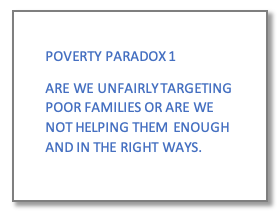
It seems after hiring the services of the Third Sector ‘007’ Josh McAllister and this week the publishing of Kingston upon Hull University’ findings we have amazingly come to the same conclusion as the first social worker 125 years ago.  The Hull report found that Children in the poorest areas are 14 times more likely to be referred to social care than children in the richest areas.  Simply, its not who your parents or family are its your postcode.

Can social work be boiled done to the simplest equation?

POVERTY = bad outcomes for children and families + Social Care intervention.

Mary’s work chronicled the lives of London’s poor in her own recording system, The Almoner’s Handbook. It highlighted poor living conditions, lack of funds to purchase quality nutritious food and a lack of social and employment opportunities.

Imagine Mary working solo in one of the biggest cities in the world, on a daily basis observing the relentless anguish caused by poverty but being powerless to change the labour market, housing, the price of alcohol or the availability of fresh fruit and vegetables.

Are we equally stuck in 2021 as social workers, merely typing up the misery of people’s lives into computers with no leverage to hack at the root causes of poverty? 

Despite being a trailblazer Mary was still a product of her time and the discrimination of the deserving and undeserving poor was evident throughout her work.

In one example she refused to assist a Lady who was found to be “gossiping in the street”, whilst another who was extremely grateful to speak to Mary received a waterbed, free GP visits, and a trip to the seaside. However, let’s not pretend as social workers we don’t find it easier to advocate for families that we have a better connection with or are in some way fond of.

Or should we ask our selves a harder question? Is sexual abuse, emotional harm and domestic violence evenly spread in households regardless of income.  For example, the middle-class professional father who enacts such violence on his wife and children and then often himself, is strangely never regarded as a social care issue.

Are there any answers?

Our Assessments

There is now an extensive evidence base in the UK around the impact of poverty including, life expectancy decline, limited healthy life expectancy, poor health outcomes for children, problematic mental health, and poor social mobility. 

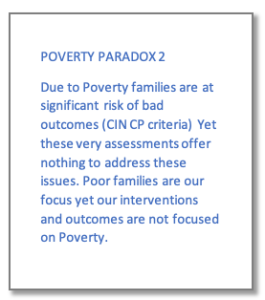
Yet do we own this evidence in our assessments? Do we in our analysis place the responsibility solely on parents, when our Child Protection caseloads are often situated (the vast majority of the time) on a select few estates in our Local Authorities rather than spread equally or randomly.

To call this out I feel we need to be brave and start using sentences such as the following in our assessments,

Whilst these parents have made negative choices and are responsible for the consequences these have had on their children, the impact of poverty and poor access to mental health services and improved work prospects have had a demonstrable negative impact on this vulnerable family.

Whilst the interventions offered have improved some aspects of parenting capacity, the lack of good schooling, positive local role models and access to pro social activities are likely to play a far greater role in the long term outcomes for this family.

As Kingston upon hull (2021) have evidenced this families poor financial circumstances have increased their prospects of being involved with social care and having concerns investigated irrespective of any individual features or characteristics.

Whilst this feels a radical step, if it’s true and evidenced based, are we not duty bound in terms of our professional standards to seek to include this in our work? Or, we are just playing a professional version of the Emperor’s New Clothes fable. Or even worse are we playing Mary Stewarts game of feeling that the families we work with are somehow bad or undeserving of good outcomes.

Situated choice

Micheal Blastland’s book the Hidden Half, raises a potential area that social workers can seek to explore to offer a ladder out of the poverty trap, using the lens of escaping a life of crime.The Hidden Half discusses the Shared Beginnings, Divergent Lives study. The study offered a longitudinal investigation over a 70 year period, with the focus being on following up life outcomes for boys in borstals in the Boston area in the 1940’s.

The basic question was who continued to offend and who turned their lives around despite the bad start. The crucial question, however, was what made the difference in those that turned their back on a life of crime.

Did Mary Stewart wonder about her families that she visited, comparing the ones who did slightly better or managed to get out of the slums with the ones who lived short harsh miserable lives (as the majority did). Possibly like social work Mary never got to see the success stories as they would naturally not be in need of her services as much due to their improved lives.

Micheal Blasland points out that the team, when looking at the data, could find no statistically significant correlation between any variable (education level, zip code, marital status or type of offence).  It seemed it was just the roulette wheel of life – RED or BLACK – return to prison or a happy and long family life.

The researches were totally stuck until they started visiting the 70 year old men by physically tracking them down (no mobile numbers in the 1940’s etc). What they quickly discovered was that the men who never returned to crime each had a story about a ‘Sliding Doors’ moment when they made a clear life choice.

One example was a man returned home to his wife after a hard day at the saw mill –
“I hate this job I could make ten times back in the gang”
To which his wife replied, 
“Quit the job and I quit this marriage”
From that point on the guy stayed in work and was never arrested again.

Others talked about solemn moments where they considered joining the army and made a life changing positive decision for themselves, or hard work and chance encounters offering up opportunities that they grasped with both hands.

In short, they all recalled making life changing situated choices that set them on a different life trajectory.

To give a current example the England forward Raheem Sterling’s success can be tracked down to two situated choices. One, his mother making the decision to leave the family home in a poor and violent area of Jamaica to live in the UK when Raheem was 4 and the other when Raheem’s behaviour was unmanageable at home and a youth worker in a residential project had the idea of a football match in the local park. Should he ask Raheem, could Raheem be bothered to go to the park, are the questions that would of swirled around their heads. The rest is history, Raheem made a positive situated choice when he very easily could have refused.

So, what has this got to do with social work?

I feel the issues we address such as child abuse, alcohol abuse, domestic violence and mental health can often lead to a narrow focus which only serves to narrow the opportunities for positive change. People are never single issues solutions and interventions should not make this mistake.

I would suggest we consider this. When a case is allocated look at how many assessments have predated yours. How many times has the traditional Children Act led intervention been meted out with no or little lasting change?

For example, would the father who has been suffering from depression benefit from an engaging employment skills course or clearing his debt. Are these actions more achievable and more beneficial than a long NHS waiting list and short course of CBT?  Or would a young mother who is socially isolated and struggling with their child’s schooling not benefit from volunteering a few days a week at the child’s school.

Do our interventions open doors up to families or do they just seek to close the Child in Need or Child Protection door behind them when they scrape through our artificial risk threshold. Whilst any intervention we offer can end up in a dead end, should we not seek the ones that would maximize the potential of the individual and their families, supporting situated choices.

Crucially I am not denigrating mental health support and traditional services, I am just suggesting that if we don’t support an expanding of horizons and options for families we are doing no better than Mary Stewart visiting the same poor families to offer help that are living in conditions they have no means to escape from.

As social workers we must believe that all families are deserving of enhanced life options. We need to be willing to explore creative options and take a chance to jointly develop a map out of their current circumstance and hopefully that may create at least some lasting change.

About the writer…..

George Bull

George has been a social worker for 10 years working mainly in child protection and Early Help. He has lectured with Jamie Scorer at New College Durham, University of Sunderland and University of Northumbria in solution focused practice.

Voices: It’s a struggle being poor

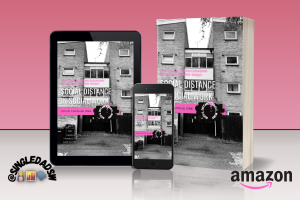
In the first ‘Voices’ that Social Work Shorts would like to bring you this is a testimony from a 38-year-old single mum living in the South of England and is taken from the insightful collection of illuminating and much needed writing in a book created by Dominic Watters (Twitter @SingleDadSW).

You can find the book at this link. 

It’s a struggle being poor
I’m a Dutch national of African descent and single mother of two boys. I have been living and working in the United Kingdom for the past 15 years. I was in a tumultuous relationship for nine years which resulted in my children and myself being made homeless. We were initially placed in a hostel for eight weeks in another borough before my local council rehoused us into a temporary one bed council complex, where we were placed with families who faced similar circumstances that I’ve been experiencing. After three years, I’m currently still waiting to be housed into my permanent place.

I’ve worked at Gatwick Airport for the past 15 years and was made redundant due to the impact Covid had on the airport. During lockdown, not only did I lose my job, my electricity and shopping expenses increased due to the kids being stuck indoors. Prior to when the government finally decided to introduce school meal provisions and the £20 Universal Credit top-up, I succumbed to using my credit card to provide for our basic needs. At times, I had to reach out to the local church for help with food and supplies.

Going through all this, I was also faced with the task of home-schooling my children in an overcrowded space and unable to engage in social activities which has been very challenging. This negative impact has definitely tested my boy’s mental health.

As if this hasn’t been stressful enough, I also endured racist abuse from my new next door neighbour’s boyfriend (they moved in during Covid) who referred to me as the N-word after a violent outburst in the middle of the night. I was both angry and scared for my children and I felt trapped in my own space. I reported this and he has been spoken to by the police. Although I hope this won’t happen again, he’s still there.

It is a real struggle having a narcissistic ex-partner who doesn’t pay child maintenance, myself not being financially secure. Living in half-way housing and trying to keep my sons unaffected has proved to be very testing for my own sanity at times but I’m pleased to say that I have found a new job as a teaching assistant at my boy’s primary school.

Snippet taken from the Social Distance in Social Work: COVID Capsule One

About Social Distance in Social Work: COVID Capsule One

A social work student facing eviction from his home and experiencing food insecurity authored this book in the hope that it could get his voice heard. As a single dad living in a council estate block of flats, Dominic @SingleDadSW lets the reader into an environment drenched in poverty. He invites some of the leading thinkers, practitioners, and people with lived experience of services to discuss the impact of the COVID crisis.

The COVID crisis made everyone aware of keeping their distance from other people because of health concerns, but SingleDadSW was reflecting on the distance between people due to poverty, culture, class, and other factors. Social Distance in Social Work: COVID Capsule One is both an action in the face of destitution, and a collection of notes from the crisis. A collection of pieces that he has curated to tell a story and capture a moment in time.

A book that discusses established and new approaches in Social Work:

  • • Social Justice & Social Distance
  • • Food Poverty & Food Insecurity
  • • Lived Experience & Living Experience
  • • Child Protection & Social Harms
  • • COVID Crisis & Crisis Capitalism
  • • Social Work During the Pandemic

Featuring all exclusive work by Ray Jones, Phil Watson, Brid Featherstone, Cal Webb, Gerry Nosowska, Simon Haworth, Lewis Roberts, Ian Gould and more… and includes a foreword by Ruth Allen, chief executive of BASW.

Book Endorsements

‘A stunning book right from the heart of exciting, newly emerging social work practitioners. At its core is a genuine commitment to the application of rights-based practice made possible by the authors personal, deep understanding of social justice and the impact of structural oppression of poverty.’

Rob Mitchell, principal social worker, co-author of ‘Social Work, Cats & Rocket Science

‘We are a human rights profession. But it can be hard to embed this into everyday practice. This book is a precious and creative contribution to understanding how we can do that.’

Ruth Allen, chief executive of the British Association of Social Work (BASW)

The transition problem – student to practitioner

In their book ‘The Lost Art of Running’ Shane Benzie and Tim Major talk about research that was undertaken with athletes that sought to explore their running gait and style. The research was conducted indoors on a treadmill so that the researchers could control conditions. They watched the athletes and learnt lots about how they ran and offered suggestions to improve. They runners got better at running.

They then moved outdoors and…. the improvements disappeared. The changes didn’t work the same. Because outdoors – real life if you like – isn’t the same as in the lab. The runners still used what they had learnt but had to re-engineer and, in some cases, relearn some of what they knew. Social Work is the same. What you learn at University and what you learn on placement gets you through the door and you then need to transfer that knowledge into the real world of practice.

Croisdale-Appleby noted this in the 2014 report Re-visioning Social Work Education and said ‘the first year of practice is absolutely vital for social workers as they consolidate the learning from their degree and develop new knowledge and skills in their first employment setting’

Playing the guitar

Let me give you another example. I’m a guitarist and have taught many people over the years to play the basics. If I was to hand someone a guitar they would intuitively know what to do with it…. to a point. They would know not to try and blow into it like it was a wood instrument. They would know it wasn’t something to help them with cooking. They would probably pluck the strings. I’d then teach them a little theory. Which string needs to be tuned to which note and what shapes to place your fingers in on the fret board to make chords to strum. We’d then practice. We’d replay, over and over again, the same shapes and learn to change between them. Over time we’d learn to play a song with the chords we had learnt and invariably the student says I’d like to play ‘song x’. So you look at ‘song x’ and realise that the guitar student knows most of the chords but needs the chord of F to play it all. F is not an easy chord for a beginner. They feel like they are back to square one and their confidence takes a knock. But over time (a long time) they overcome this, learn F, and a whole other set of chords, and they become proficient enough to play with other people and maybe join a band. They have to learn to then play in time with others… this is not as easy at it sounds. Then… someone might ask them to improvise a guitar solo which they’ve never done before so they use their intuition! ….based on the theory they know and the practice they have done Full circle! And the first time they do it it may well be alright but it might not be brilliant but they’ll practice and it will get better

Intuition > Theory > Practice > Time > Intuition (or as we call it Practice Wisdom)

Starting in practice

Evidence from Grant Sheridan and Webb (2017) suggests that newly qualified social workers felt ‘quite well’ or ‘very well prepared’ for practice in general. However, when this is broken down into preparedness for specific tasks, confidence levels drop. Essentially I’d suggest this is because specific tasks are often context specific (the type of social work you are doing and the organisation you are doing it in) and role specific – that is – not generic. You have to reapply the skills from the treadmill on the outdoor running track.

The conclusion of formal social work education is only one layer of the learning experience which is continuous throughout your career (or should be).

They also found that respondents felt most prepared to ‘promote and enable’ (89 per cent) and least prepared to ‘intervene and provide’ (32 per cent). Again because intervene and provide is context specific whereas promote and enable has a more value base feel about it. Respondents in the study reported feeling ready to conduct assessments, build relationships and communicate but less prepared for commissioning services and dealing with IT systems. Well they would because you can’t teach this as it is too organisation specific. They said they felt prepared for applying theory and demonstrating values but not for caseload management. It’s not the face to face work that seems to cause the stress but the ‘office’ function the research tells us.

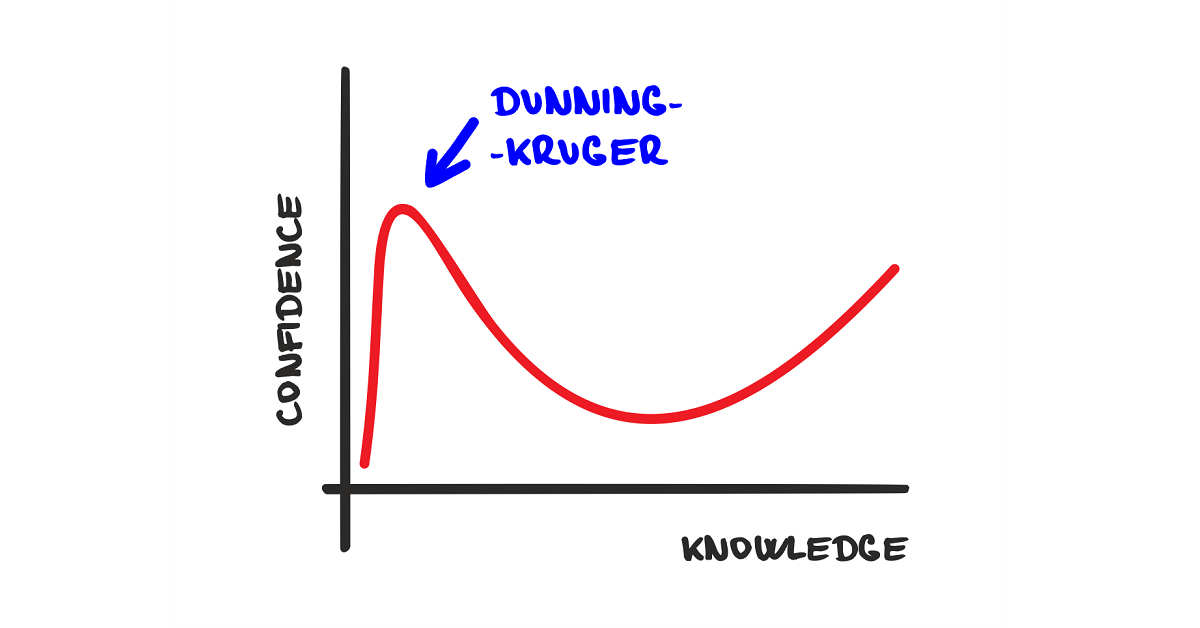
The Dunning-Kruger effect

There is also something else going on that relates to the Dunning-Kruger effect. There are certain points in our lives where we are likely to overestimate our abilities and feel quite confident. Usually when we have achieved something that has taken great effort. Like completing a degree or securing a promotion or becoming a manger… or becoming a lecturer! The problem occurs when you transition from something where you are at the top of your game and you have to translate that knowledge into something else. This transition tends to undermine your confidence and you feel like an imposter.

Objectivity's Blind-Spot: The Dunning-Kruger Effect | Procrastination.com

Moving from being a student into practice is one such transition. You’ve just graduated and you know loads of stuff. You’ve just had a great placement and a got a good mark for your dissertation and then you have to translate the knowledge you have (which is valuable) into the new practice environment. You are likely to feel immediately out of your depth and like you know nothing and your confidence will take a hit.

At this point you need to remember some things. This feeling is completely normal for us all, to one degree or another, when we transition. You do know loads of stuff you just need to rework that knowledge into a new environment – stay calm. When transitioning it’s essential to stay focussed and organised. You are going to have to ‘lean into’ this for a while and it will take pretty much all of your energy. As in the diagram above your confidence will take a hit but apply the theory, engage in practice, take your time, and you will develop the practice wisdom to climb up that curve again….. and next time you transition you are likely to have to go through the same process again! Joy!

Remember your degree can not completely prepare you. It can only give you what you need to get started. It gets you the key to the door. Like people say about driving a car. You only really learn to drive a car after you’ve passed your driving test. This is the same. You are qualified, you are good enough, you can do this… but… the transition is going to be difficult and now you know that you can prepare for it.

  • Have growth mindset, a positive attitude, and that will help.
  • Keep on top of your planning and organisation and take time out for yourself.
  • Don’t lose yourself in the transition.
  • Work with your manager and mentor in an honest way and seek out support.

Whenever things are changing those who create as much order as possible do the best.

References:

Newly Qualified Social Workers’ Readiness for Practice in Scotland Scott Grant, Lynn Sheridan and Stephen A. Webb British Journal of Social Work (2017) 47, 487–506

Croisdale-Appleby, D. (2014) Re-Visioning Social Work Education: An Independent Review, London, Department of Health

Getting to grips with theory: Transactional analysis

I honestly don’t know why but I’m a huge fan of ideas and theories that emerged in the late 50’s and 60’s. It was certainly a time when ideas about the importance of ‘self’ took hold with people like Rogers and Maslow exploring how to be our best selves – scaling the dizzy heights of self-actualisation! One such idea to come out of that same era was Transactional Analysis which is a way of examining the interactions between people.

It was developed by Eric Berne (1910-70) in the late 1950’s as a basis for understanding behavior through communication. Its origins are in groupwork where the transactions – the communication interactions – were analysed to develop understanding. It draws on a range of theoretical perspectives and considers ideas about the subconscious mind and its influence, so, is psychoanalytical. It is humanist in that sees the individual as important, and cognitive as it considers cognitive processes and seeks when necessary to attempt to adapt cognitive processes.

It can be used to explore the Individual, two person relationships and group interaction. Let’s explore its components.

Using Transactional Analysis in the Workplace - ReadyToManageStrokes

‘Strokes’ is a motivational concept where a ‘stroke’ is an act of recognition from one person to another. The communication of acceptance or ‘liking’, is referred to as positive stroking, whereas criticism and ‘discounting’ are negative stroking. There are parallels here with the concept of reinforcing in behaviorism and also ideas of affirmation and validation

Positive strokes would be things like praise, compliments, recognition, affection, rewards, sympathy, consolation, and even self-satisfaction from a job well done. Negative strokes would be put downs, criticism, ridicule, scolding, or punishment. Strokes can be ‘Conditional’ that is they relate to what you do and are not directly about you as a person – ‘you did  that task very  well’. Whereas unconditional strokes are not about what you do but are about you – ‘I really like you’. There is no condition just a statement.

Strokes can have ulterior motives where people say things to gain favor. I remember one student I taught used to say things like, ‘You’re looking good today Stephen – lovely shirt’, usually around assignment marking time!

Life positions - I'm okay, you're okay - GP-Training.netOk-ness

This idea refers to a basic attitude of acceptance towards self and others and states that people adopt one of four positions.

  • I’m Ok – You’re not Ok – this is rejection and belittling of the other. Maybe it’s ‘I don’t like you’ or ‘I don’t like what you represent’. It could be because the other person is constructively challenging and the person doesn’t like being challenged.
  • I’m Ok – You’re Ok – the preferred position – acceptance of self and others. This is the state we need to try and establish when working with people. Such a position can generate forward momentum.
  • I’m not Ok – You’re Ok – reflects avoidance of the other and maybe suggests things to be explored with the person. At least if the person thinks ‘you’re ok’ then this may give you a starting position as they may trust what you are saying.
  • I’m not Ok – You’re not Ok – Berne suggests reflects a depressive hopeless attitude to life. The question is how to create forward momentum and change in such a position.
A history of Eric Berne
Eric Berne

Ego states

Berne suggest there are three ego states – the parent, the adult, and the child. We can all, whether we are adults, parents or children adopt these ego states.

The Parent Ego state is when we adopt behaviours, thoughts and feelings copied from parents or parent figures so is a ‘taught’ ego state. The Adult Ego state is found in behaviours, thoughts and feelings which are a direct response to the here and now and are a ‘thought’ ego state. The Child Ego state is where we replay behaviours, thoughts, and feelings from childhood and is a ‘felt’ state.

Parent (“exteropsyche”): is a state in which people behave, feel, and think in response to an unconscious mimicking of how their parents (or other parental figures) acted, or how they interpreted their parent’s actions. For example, a person may shout at someone out of frustration because they witnessed that as a response, a way of being, in a parent or important person.

Adult (“neopsyche”): a state of the ego, which is very pragmatic and practical, thinking things through logically to make predictions and maybe absent of major emotions that could affect success. Learning to strengthen the Adult is a goal of Transactional Analysis. While a person is in the Adult ego state, they are directed towards an objective appraisal of reality. This resonates so much with me in terms of my writing about productivity and being organised. Developing this ego state means we can relate to people and events in a structured way. Not lacking emotions necessarily but being in control of them.

Child (“archaeopsyche”): a state in which people behave, feel and think similarly to how they did in childhood. The Child is the source of emotions, creation, recreation, spontaneity and intimacy. We need to spend some time in this state I’d argue but it needs to be carefully managed.

Transactions that are complimentary sustain and lead to smooth conversation

So, Adult to Adult could result in solving a problem, whereas Parent to Parent could lead to critical gossip (something lots of people enjoy! We are only human!). Child to Child or Parent to Child could be about playing together.

Banning Small Talk From Your Conversations Makes You Happier, Says Science  (Ask Any of These 12 Questions for a Change) | Inc.com

Crossed transactions cause communication to be broken and give us what is sometimes referred to as ‘a bumpy conversation ride’. Where the stimulus in the conversation originates in Adult and is directed to Adult but the respondent returns conversation from say Child directing it to Parent, or equally, Parent to Child, we may see a problem. I’m wanting to have a serious productive conversation, but I get a petulant child response, or a critical parent response and I’m left on the back foot not knowing quite what happened. Or indeed I’m after a bit of jovial childlike banter and I make a joke that falls flat on its face when someone responds from Adult and I’m left deflated. This happens a lot with my jokes…I need to think about that…. 😉

Within each of these ego states are subdivisions. Parental figures are often either more nurturing or more criticising. Childhood behaviours are either more natural (free) or more adapted to others. These subdivisions categorise individuals’ patterns of behaviour, feelings, and ways of thinking, that can be functional, beneficial, and positive, or dysfunctional, counterproductive, and negative.

Critical Parent can be lecturing or judging – all about what you should do or shouldn’t do. Remember this is not just ‘real’ parent to ‘real’ child – you can be ‘in’ Critical Parent in adult conversations. ‘I don’t know what you do with your time. I need the report now!’

Nurturing Parent on the other hand is sympathetic, advising, and takes care. ‘You seem to be missing deadlines can we talk about what we can maybe do to help?’

In the same problem above Adult may be objective, rational, and problem solving. ‘Let’s reach an agreement on giving you a little longer but it must be done by then. Let’s see what work we can take off you to give you time’.

The Adapted Child may then play the game (Berne loves game playing ideas) and may manipulate the situation trying to drive Adult into Nurturing Parent. ‘I’ve just found everything so hard lately’. Or maybe will be submissive and conform to Adult expectations. ‘Yes, whatever you want me to do’.

The Natural Child might be playful or impulsive and may rebel. ‘Sorry but I can’t I’m taking today off – nobody bothers about the dates things are due anyway!’

Strengths-based conversations: quick tips for practiceHow is this relevant to SW?

  • It helps us understand the other person
  • It gives us opportunity to consider how to respond in a helpful way to build rapport.
  • It helps communication by trying to shift the other persons ego state to Adult to establish an Adult to Adult conversation.
  • TA tells us you can have considerable impact on modifying behaviour by how you communicate. The Adult ego state seeks to ‘control’ the other ego states.

Using TA for effective communication

For effective communication you need to keep the transaction complementary i.e. focus on sender to receiver and receiver to sender where the message is sent to the ego state from which you expect a reply. Using ego states we can look at how others communicate and how we communicate with others.  It’s possible to identify which ego state we are in and which ego state we are expecting a reply from.

We can also use TA to help us plan transactions. For example, we can identify which ego state would be most valuable for us to send the message from and which ego state it would be better for it to be received by. If we receive a reply from the wrong (non expected) ego state then we can either try to shift the other person’s ego state or if we cannot do this it may be better to stop the communication and try again another time when the person may be in a different ego state.

We can listen to people’s communication to identify if they are habitually in one ego state and then decide if communication to that ego state would be appropriate or not. TA therefore can be used to elicit the reactions you want from other people (and this will happen consciously or unconsciously).  We are trying to achieve Adult to Adult

We can help communication if we need to by trying to shift the other person’s ego state by inviting people to move into a different ego state. They may not always move into it though, particularly if someone is habitually in one ego state. Do this by acknowledging their current ego state (by the appropriate message or response) and then invite them into another ego state by the words (and body language) which you use.

Transactional Analysis implies that you can have considerable impact by the way you communicate with others.

You can use your Adult ego state to think about what behaviour is appropriate and then engage in that way to facilitate helpful conversations. 

Invisible: Two Presidents, Catwoman and Social Work Reviews

Last month the government announced a wide scoping investigation into childrens’ social work and the care system with Frontline boss Josh MacAlister appointed as the head honcho.

Josh is a rising star of private sector social work, he’s the brainchild of Frontline a programme that seeks to fast track top students hopefully from Universities that have rowing and lacrosse teams to be social workers putting the profession on an even footing with legal careers. It offers a short 5-week intensive summer school before entering practice and placement, with a clear trajectory of management and beyond. Why should social work not get the best and smartest kids from University is the rhetorical question it seems? For nearly ten years he has received funding and been a go to man for the conservative government, in short, he is the archetypical Govian innovator (Michael Gove himself in the care system for 4 months as a child).

Enter Catwoman

I hate to bore you all with yet another Catwoman and social work story, but I think there is a surprising link found in the biography of Ertha Kitt.

Ertha was born in 1927 on a cotton planation as a consequence of a rape by a white doctor. Her mother (who was half African American and half Cherokee) was forced to give Ertha up to another family as her then new partner could not abide her “yellow” mixed race skin. Her new family raped and abused her and set her to work as a slave in their home leaving her to be tormented by their own children. Her route to stardom is one of the most remarkable stories in modern American history.

The indefatigable Ertha became a sultry actor (batman, mission impossible, Disney, Miami Vice), singer (Santa Baby) and performer (too many stage plays to mention). One of many big breaks came when she got a once in a lifetime role as Catwoman in the ultra kitch 60’s Batman TV series! KAPOW!!!!. 

During this time Orson Wells described her as “the most exciting women in world” 

50 years before The Black Panther movie one year before MLK got assassinated there was Eartha holding a gun to the head of the Joker, seducing Batman and generally stealing every single scene. Catwoman’s role would be to upset the status quo make villain and hero feel uneasy and unsure about what they have previously assumed and the positions they occupied.

During this exact period President Johnson’s wife, the extraordinarily named Ladybird Johnson, held a meeting at the White House to discuss why the youth of America had become so disaffected. There was rising crime, broken homes, drugs and gangs, all of which were major concerns. All this set against the disastrous Vietnam War Johnson had started, a war that was a bad idea executed badly that costs millions of lives.

To crack the problem Ladybird assembled a white crowd of socially clambering Stepford Wives and to quietly sit in the corner and to provide ‘faux’ racial balance, Eartha. With the pristinely ironed and noxiously perfumed beige mob assembled, speaker after speaker, talked about the tidy highways, excellent school system and really nothing to do with disaffected youth let alone any offer any solutions. Towards the end Eartha raised her hand and summed up the mood for the youth of America thus,

“Boys I know across the nation feel it doesn’t pay to be a good guy,”. “They figure with a record they don’t have to go off to Vietnam. You send the best of this country off to be shot and maimed”.

Hearing this Ladybird Johnson bursts into tears and was furious with Eartha. A little later her husband the president walks in and Eartha again unprompted starts questioning him about the war, motherhood and the root of the problem. The body language in the picture below explains how he responded to her.

TRUTH TO POWER!!!!!

Eartha did not care one jot for upsetting the room or the ultimate decision maker the president, she cared more for the children than her own standing.  Her reward for upsetting Ladybird and the president was the CIA basically shut her career down with her not working for over 15 years in the US again.

I am 10000% confident the review by Mr MacAlister will not dim his lights in the hearts of the senior Tories or his bank balance, he will not risk his career one jot so his suggestions will be palatable to his pay masters.

However is Eartha’s position a foolish one to occupy. The economist in me would suggest an outcome that optimizes the probability of something being accepted or achieved and the impact of the expected outcome, even if your right implementation is important. What value in making a suggestion that you know will never be put in place, or if it is watered down. For example Munro’s review (as she acknowledges) got universal nods of approval but little policy or actual change.

The Trade off being

MacAlister – High chance of acceptance + Low potential impact
v.
Ertha – Low chance of acceptance  + High potential Impact

Tony Robbins

Another maverick who spoke to a president is the I Am Not Your Guru documentary maker and motivational zillionaire Tony Robbins. He was invited with another group of the politically harmless to speak with Obama in early 2014 about his health care bill.

Whilst Tony agreed with Obama’s policies, he made a point that stunned the room. Tony explained to the president that the error that he is making is that his policy on issues such as health care are based primarily on Obama being the smart and him feeling his policies are the best ones, however for policy to work this is simply not enough. It’s about relationships and if you don’t take the other half of America with you and your party will pay a price (and look how that turned out insert Trump MAGA emoji here).

The message here is even if you have a good, or even the best idea it has to be gripped and accepted by the populous for its implementation to be successful. Johnson and Obama could not be further apart politically, but they fell on the same trap that is looming over MacAlister’s Review. The first sign of this came when MacAlister jettisoned many voices and tarnished thousands of potential relationships with the people he seeks to aid, namely care leavers and other stakeholders. 1000 care experienced people applied, 40 were successful of which about 10-15 will form part of the review board.  (You stand a better chance getting into Oxford or Cambridge with this offering a poignant Irony to the type of student McAllister wants to have on his Frontline programme.)

Imagine for a second a care leaver whose life story is a series of assessments, letters, and case notes on a computer, being asked to help but just getting another generic “no thanks” response to your ideas.

Ex piano tuner Alison Moyet I feel comes close to an accurate description in her 80’s hit Invisible,

You’ve got me so confused and there’s words I could use
But I’m afraid to say them
I feel I’ve been had and I’m boiling mad

You don’t have the time and you won’t spend a dime
Not even to call me
You don’t know I exist and I wouldn’t be missed
If I had the nerve to quit you

Invisible – I feel like I’m invisible
You treat me like I’m not really there
And you don’t really care

I wonder if Josh Mccalister is a Moyet fan?

Earlier this month I attended a conference that Mr Mcallister spoke at concerning Connected/Kinship Care.

At one point an experienced Carer/advocate raised the issue of several disparities between work/leave entitlement between kinship care and adoption and the post code lottery of levels of support and financial assistance to carers. MacAlister responded that he will look into theses issues and address them were possible. His unique cocktail of suave confident good looks, positivity and engagement really convinced me and likely many others in the conference. He on the face of it did better than Obama and Johnson.

However, after a day’s contemplation I realised the scale of ironing out these inequalities in just one small corner (kinship care) of his vast review. The following would have to be re-aligned.

  • Employment law, The Paternity and Adoption Leave Regulations 2002
  • Children (leaving Care Act) 2002
  • SGO support regulation
  • Local Authority financing

The scale of this task is tremendous and the votes in parliaments, debates and implementation would need to go on for many years beyond the publishing of Mr MacAlister’s review. Potentially Mr MacAlister is naive, and we can’t expect him to know the ins and outs of every area, but each of his recommendations I feel should be separated between easy wins and herculean legislative labours. Any one can provide a wish list, the real magic is in high quality and lasting implementation.

I wish MacAlister all the best with his review, but would urge him to be the Eartha and Tony Robbins in the room and don’t fall into Obama and Johnsons trap in leaving the Invisible people behind just because you think you’re the smartest.

Links

Munro’s review

Frontline website

Moyet singing

Eartha Kitt meets president

Solution Focused Gorillas

In 2006 Cadburys poisoned 37 people with Salmonella and the treasured British company was brought to it knees. Fined millions, reputation in the trash, hostile take over talk, how could it ever recover…………….

Cadbury’s response was marketing genius they ran one of the most famous adverts of the past twenty years.

[You really should watch it (below) –  it’s amazing! It’s 4 and half minutes long (this link is a shorter version – but if you have the time watch the long one – it is sooooo worth it!]


The advert features no humans (Phil Collins excepted) and no chocolate, it just creates a warm positive enjoyable feeling exactly the feeling that Cadburys wants associated to their brand.

By honing down to base psychology Cadburys have distanced themselves from their Salmonella existential crisis.  The advert was entirely positive, feel good and very importantly simple. Cadburys chocolate will make you feel like the advert does.

The next video….. well…. watch it then I’ll tell you….


It features the very same gorilla as in the Cadbury advert (honest!) in the now famous experiment by Simon and Chabris (2009). In the experiment the focus of the viewer is requested to be entirely on the white team passing the ball, the human brain squarely focuses on its target to the deletion of everything else.

Nearly all test subjects fail to spot the gorilla but can count accurately the number of passes of the ball, as soon as you are told of the gorilla it is 100% obvious, as gorillas always are.

Before the gorilla starred in adverts and experiments, he used to live in the jungle where he met famous primatologist (monkey expert) Diane Fosse.

The male gorilla before Fosse (and others Sigourney Weaver etc) had always been considered to be totally dominant in sexual situations with the female subservient and vulnerable.

As Matthew Syed points out in his excellent Rebel Ideas (2019) however, primatology was full of stuffy bearded men in the Charles Darwin mould who had a massive blind spot about female activity. They accepted the dominant view and importantly had no interest in challenging it creating a jaundiced perceived wisdom. Syed observes that it was not until a critical mass of female scientists entered the field that the frame of reference shifted and female gorillas were found to have agency and power, and, could select a range of sexual partners.

The story of this gorilla I feel is useful to solution focused work as it makes clear a very important point.

“You see what you aim at”

This quote by, at times controversial, psychologist Jordan Peterson I feel holds a lot of weight for social care. The power, and indeed ‘blindness’, that can be achieved by a clear focus is both useful and dangerous.

Here are some examples –

The social worker whose main focus is the assessment rather than supporting lasting and client led change, or the family whose only focus is to seek the end to the intervention never questioning or considering possible future directions or opportunities.

Conversely the focus on one particular issue for a period of time can yield results as nobody can deal with many problems all at the same time (I’m sure many of us have all been to child protection or adult safeguarding meetings where the list of identified issues is long).

To balance this I feel as social workers we need a wide lens to be open to risky ideas that will reverse challenging situations (Cadburys),  we must be brave not to fall under the cloak of perceived and dominant thinking (Dianne Fosse) and to be focused on the detail but not to miss the gorilla in the room (Simon and Chabris).

George Bull

George is a Social Worker at the Connected Carers Team South Tyneside. He has been a social worker for 10 years working mainly in child protection and Early Help. He has lectured with Jamie Scorer at New College Durham, University of Sunderland and University of Northumbria in solution focused practice.

References:

Simon and Chabris (2009) https://journals.sagepub.com/doi/10.1068/p281059

Rebel Ideas, Syed (2019) https://www.amazon.co.uk/Rebel-Ideas-Power-Diverse-Thinking/dp/1473613914

The Nocebo in Social Work – what can the COVID vaccine trials tell us about social work practice?

In the COVID Vaccine trails boffins at Oxford gathered 40,000 people (80,0000 arms) and split them into two groups.

One would get the vaccine jab and the other a harmless placebo.

The placebo is used in what is know as a “double blind” trial as it provides the gold standard to set the vaccine against. The placebo has a measurable positive effect that is well established in the scientific literature.

This effect is not caused by the material in the placebo jab but from the psychological expectation of a positive change.  A great example in the literature is knee operations. It was shown that just going through surgery cutting into the knee and doing nothing reduced patients pain and increased mobility (amazing!)

The Placebo has an evil twin the Nocebo. This is where despite a treatment being benign (chemically and medically) there are negative impacts psychologically which cause measurable side effects like nausea, stomach pains, itching, bloating, depression, sleep problems, loss of appetite, sexual dysfunction and severe low blood pressure.

(An interesting side thought is how would anti-vaxers be impacted by the vaccine given their world view is dead set against it, their mind might cause more damage than the vaccine prevents?)

What does this all mean to social work.

I wonder that given we know as social workers that families are often fearful, sceptical and resistance to intervention or change it is possible that our intervention may cause harmful effects, due to the dread and lack of belief.

Example: A mother who is worrying and not sleeping prior to a social work visit, her body physically and mentally braced for a “punch” from a social work Tyson Fury.  Her fight or flight mode (driven by her amygdala) is switched on, her capacity for learning (controlled by her frontal cortex) is switched off, and the body is anxious, inflamed and worn out.

In this scenario the over all impact on the mother health physical and mental may very well be negative, even if the social worker has read every word of Carl Rogers, Community Care magazine and their lecture notes.

How can we beat the NOCEBO. The answer is in its twin the placebo – the power of positivity.

As social workers we have to be the most positive and hopeful person in the room. We have to ‘defrost’ problems and open up a new path for families.

In short, if we don’t feel enthused, or don’t feel confident in the effectiveness of our models’ the families certainly wont. And given their worries about our intervention we may be doing harm. I feel this may be particularly true in cases where there has been repeated failed interventions over the year, as why would you have positive expectations of your 5th Single assessment?

Food for thought.

George Bull

George is a Social Worker at the Connected Carers Team South Tyneside. He has been a social worker for 10 years working mainly in child protection and Early Help. He has lectured with Jamie Scorer at New College Durham, University of Sunderland and University of Northumbria in solution focused practice.

Getting to grips with theory: Biology – deterministic?

Philosophers forever have contemplated just where the mind is and how the mind relates to both brain and body. Descartes, a French philosopher from the 17th century, was closely associated with an idea called dualism. This idea holds that the mind is non-physical – that it’s situated somewhere other than the brain or body. It’s not a substance – it’s in fact consciousness itself. He called this the mind-body problem. He said that mind can exist outside of the body and that the body cannot think. Mental phenomena are not physical. This gives birth the idea of soul – that there is a part of us that is not physical that exists beyond us

Rupert Sheldrake – a contemporary philosopher and man of faith says that our minds are part of a greater mind – that our minds exist outside of us and are part of something.

He used the analogy of a bucket of water reflecting the moon. The moon is clearly out there but it is also in a sense in the bucket. This is like our minds, he suggests. They are part of us – but they are also in other places. I don’t necessarily agree with this but it’s an interesting idea that has been with us for a long time.

With developments in neuroscience we can very much see that when the mind is active the brain is active. There is a contemporary argument that our mind is made up of nothing other than the physical brain, the chemicals, and the electrical impulses that take place.

Many think that as a consequence of new developments in neuroscience we can’t ignore the fact that many of our emotions and our responses are fuelled by chemical reactions in the brain. Think of nothing more than the fight or flight response that is driven by cortisol and adrenaline. When we’re stressed or scared, we become flooded with those chemicals and we respond to the presence of those chemicals by ‘fighting’ or ‘flighting’. This fuels a response in our sympathetic nervous system. We have another system called the parasympathetic nervous system which also has a little two-word analogy – the ‘rest and digest’ system or sometimes the ‘feed and breed’ system. Because when that system is activated we relax enough to take care of some of the other functions that our bodies needs to undertake in order to remain well. What we know is that if we are in a constant state of stress and if our sympathetic nervous system is dominant then our parasympathetic nervous system doesn’t get a look in. This, in many ways, is the ‘bio’ part of the biopsychosocial model.

I’d argue that as social workers we focus quite a bit on the social part of that model and to a significant extent on the psycho part of it, but we neglect the bio part. Emma Zara O’Brien in her book ‘Psychology, Human Growth and Development for Social Work’ (brilliant book – buy it!) says that the brain is arguably the foundation for, and core of, a person’s future development, behaviours, and experiences. She suggests that not being engaged with neuroscience or the biological underpinnings of human development reduces social workers ability to work alongside and with other professionals.

For many years it was believed that once we reached adulthood the brain was pretty much fixed. We know this now not to be true. The brain has a plasticity – an ability to change and develop. The brain reacts to changes in environment shaped by experience both positive and negative in children and in adults. Harari in his excellent book ‘Sapiens’ talks about this. He talks about our historic animal brain. I can relate this very much to how I see my dog ‘operate’. Essentially primitive brains work in two ways objectively and subjectively. So, my dog knows that if she runs into something it’s hard and it hurts. She knows that the world is full of smells and structures and she knows subjectively how she feels about them. She experiences excitement when she gets treats, she experiences fear if she doesn’t understand something, she experiences delight when having her tummy tickled. She understands the world in these simple objective and subjective ways. One of the problems for our human, developed, brain is that we have the capacity to move beyond objective and subjective understanding to know that there are things out there and feelings inside of us. But those feelings inside of us are still being driven by our primitive brain.

The amygdala the thing driving our fight or flight response is one of the oldest parts of our brain that we have and it’s not clever in the way it deals with things. It’s a one trick pony. It fuels us with adrenaline and cortisol. Humans have developed intellect and create stories about objective things and subjective experiences. We use everything we have to construct ideas of the world.

At birth our brain is 25% of its eventual adult weight. By a child’s second birthday the brain will have grown to 75% of its adult weight. This shows how much development of the brain is going on in the first 2 years of a child’s life as it explores its environment and experiences what’s going on around it. The change is rapid. The child is born with innate reflexes and as the brain develops the child develops ways to take control of these innate reflexes.

Our patterns of communicating are largely shaped by our early experiences from our primary caregivers. The brain needs a stimulating environment. If a child is severely neglected the brain does not develop normally. Sometimes pathways for language can be lost. The brains of children who’ve been denied stimulation can weigh less than the brains of children who have had such stimulation.

At around three years old the hippocampus matures, and this allows the retention of memories to begin – children have few memories before this time. Between the ages of 6 and 13 a growth spurt affects the brain regions concerned with language and spatial relationships. These changes improve thinking and social development and fuel abilities like being able to read, and social abilities like being able to make friends. Early experiences shape the people that we become.

Dr. Sunderland in the 2006 book The Signs of Parenting suggests the following. The developing brain in those crucial first years of childhood is highly vulnerable to stress. Many parenting techniques that are common can upset the delicate balance and stress response systems in the child. This can cause actual cell death in certain brain structures. Quality of life across the life course is dramatically affected by whether or not you established good stress regulating systems in your brain in childhood. One of the amygdala’s main functions is to work out the emotional meaning of everything that you experience. If the amygdala senses that something threatening is happening to you it communicates with another structure called the hypothalamus and this part of the brain actions the release of stress hormones which can prepare your body for fight or flight. Sunderland suggests that if you were left in childhood to manage your own painful feelings on your own your higher brain may not have developed the necessary wiring to be able to perform those wonderful stress managing functions. But all is not lost as the brain is malleable so talking therapies and other life experiences can mitigate against this. But, sadly, some people are left without this opportunity to transform.

The adult brain is fully mature at around 25 years of age. At this age and further into adulthood we have more thoughtful perceptions of the world around us (hopefully!) as the prefrontal cortex is fully developed and we can consider the consequences of our actions through reasoning. A lot of what I’m interested in in terms of self-care has implications here. Exercise promotes the development of brain derived neurotrophic factor. Brain-derived neurotrophic factor (BDNF), is a protein that stimulates the production of new brain cells and strengthens existing ones. When you release BDNF it helps grow brand new brain cells and pathways. High levels of BDNF makes you learn faster and remember better. BDNF also increases your brain’s plasticity – its ability to adapt. When you face stressful situations BDNF protects brain cells and helps them come back stronger. Exercise naturally raises levels of BDNF in your body. Cardiovascular exercise is best and, while a one-off session does no harm, BDNF increases more effectively with regular engagement in exercise. Your hippocampus, often referred to as the brake to your amygdala, shrinks as you get older and BDNF can maintain and even enlarge it.

When you rest (and meditate) you brains Default Mode Network is activated. This is a series of interconnected parts of the brain that get to work once we stop concentrating on external things – once we shift from outward focus to inward focused cognition. Interestingly people who rest effectively have more complex and better connected DMN’s. The complexity of our DMN shapes our capacity for self-awareness. Daniel Goleman says this leads to us being better pilots of our lives, helps us imagine our future, and gives us a greater ability to show empathy.

Our biology then has a significant impact on how, and maybe even ‘who’, we are. This begins to be shaped in our childhood and can continue to be shaped as adults. The impact is a direct consequence of environment, others, and self. We need to attend to all of these things for our personal wellbeing and, as social workers, need an awareness of these connections to help inform people of the potential for change and support people to facilitate such change to become those competent pilots of life.

Getting to grips with theory: Social Constructionism

In order to explore Social Constructionism, I feel we need to take a step back and we’ll do that by having a think about how we know what we know.

Let’s start with positivism. Positivism is a Philosophical position about knowledge – the how we know what we know bit. It’s a belief that it is possible to establish ‘objective truths’ – facts – about things. In social sciences it would be an attempt to apply the same approach as you would to the ‘natural sciences’ and some would argue that that is not possible or even helpful. Positivism would search for concrete causes and causal links.

But maybe it’s not that easy to do such a thing after all nature (things like physics or chemistry for example) is a set of ‘impersonal forces’ but society involves a mixture of forces (e.g. the political, or culture etc). The decisions and actions that people carry out they, in some ways, make for themselves. How human beings interpret a situation is crucial which means there’s no one answer because we all may interpret things differently. Social sciences therefore are concerned with meanings and reasons rather than causes. You might argue that Positivism looks for certainties that are not there.

This takes us to postmodernism. Postmodernism is a school of thought that rejects the notion of objective truths and natural laws and ‘grand theories’ for explaining human behaviour and the world. It is also critical of the idea that developments in science and technology will inevitably lead to improvement (modernism). This is an interesting thing to think of when you have a moment or several! Are we better off as a consequence of the modern world? Alvin Toffler in his 1970 book Futureshock says that we as a human animal are colliding with the incessant change we see and that we are simply not biologically ready for the modern world – needing to be always switched on and always ready to go! Postmodernists feel there is no absolute understanding of society or reality and our sense of reality is shaped through social interactions and processes.

And this leads us to Social Constructionism. Social Constructionism is critical of the positivist approach to knowledge – that everything is knowable as an absolute fact. Our historical and cultural context is important, and knowledge and reality are constructed in our daily interactions and conversations which in turn shapes our knowledge of ‘how to go on’. Different constructions are maintained by patterns of action – ‘practices’ – the way we conduct ourselves in situations for example. There is a construction of lecturer – you expect certain things from me when I’m being one. And there is a construction of student – I expect things from you when you are being one. And others have a view on what ‘student’ is. What if my view and your view and their view are all different? Because they might be. I think you’re a vessel to be filled with knowledge. You think you’re a customer who demands what you need to know to pass the assignment. And others…. Well they could construct you and I in all manner of ways… and they do!

Language describes and defines things and as such has power. Harari in his book Sapiens explains that as the human animal we are the same, as a starting point at least, as other animals. We look at things from a subjective and objective point of view. Objectively we know that things are hard – like if we walk into them – or things are wet – if they are poured over us. We also have a subjective point of view – I’m afraid of heights! It makes me feal fear – and I have a physical reaction to it – my legs turn to jelly.

Harari goes on to say though that unlike animals we tell ourselves stories about things that are imposed on top of these objective and subjective realities. We tell ourselves stories called our family, or our culture, or my job. We tell ourselves stories about what ‘parent’ means or what ‘school’ means, or what ‘student’ means. We have an idea for ourselves sometimes, but that idea is born out of stories we have been told by others – maybe by our cultural position, or through what we have read, or the media. So those stories both describe and define something that will have some similarities with others but will also be nuanced – slightly different – and in some cases, possibly across culture for example, very different. Wetherell and Maybin (in Stevens – Understanding the Self 1996 Sage London) says that this also extends to feelings – quoting Rosaldo (1984) ‘Feelings are not substances to be discovered in our blood, but social practices organized by stories that we both enact and tell”

In terms of this construction of self the person and social context merge because the boundaries of both can’t be easily separated from each other. Psychology, it could be argued, seeks to switch off the social context and the influence of others so that the picture of an individual’s psychological make up is not complicated by such things. Social constructionists say this is simply not doable.

Language is not just a way of describing something that already exists. Words do things as well as having meaning. Language is not a mirror reflecting the objects in our world, but a tool that constructs our world. This brings us to the idea of discourse. Discourse, as defined by Foucault, refers to ways of constituting knowledge that together with the social practices, forms of subjectivity, and power relations, form more than ways of thinking but actually produce meaning.

So, discourse is a systematic ordering of language involving certain rules, terminology and conventions, such as the legal or medical discourse – or indeed social work. Social work has a whole language of its own – Assessment, Care Plan, Safeguarding, Capacity – all things that have very specific meetings within social work discourse and may have other meanings elsewhere. It is a group of statements which provide a language for talking about a particular kind of knowledge about a topic.

Knowledge is flexible, not necessarily concrete, it moves and shifts. The particular ‘common sense’ view of the world prevailing in a culture at any point in time is bound up with power- these are referred to as normalising truths – we normalise or accept as given a particular truth or version of something. Think about the construction of gender or ethnicity over the last 200 years where certain versions were accepted or tolerated by many. This leads to social practices or ‘sites of practice’ that perpetuate that view of the world and marginalise alternatives. It gives us a particular way to look at things that may prove hard to shift because they create opportunities for power that can be used to maintain a position. Powerful ‘knowledges’ keep us in order and get us to control ourselves through the acceptance of the status quo.

So how we construct our reality, the things around us, is influenced by others like family, friends, and colleagues, and by things like media and government. These constructs have a power that is found in them and in the language that describes and defines them.

Social Constructionism recognises ‘the importance of a much more fluid and artistic form of knowledge’. It also suggests that there are complex uncertainties which fits with what we know in social work. How we construct things is fluid and needs to be constantly refined, explored, and challenged I’d argue. Social Constructionism suggests that practices should resist accepted and powerful forms of knowledge.

Social Work is not merely the exercise of ‘technical rationality’. Technical Rationality uses measurements, and empirical research, applies theory, uses instruments and frameworks to collect information, and works towards a ‘truth’ about individual needs. It helps the worker, in the role of expert, generate the ‘right’ answers.  As a contrast ‘Practice moral’ offers an interpretation of need based on values, empathy, and experience. It uses reasoning and accepts a variety of perceptions from within the service user’s life (Lishman 2014). It acknowledges that real world problems are ‘messy and indeterminate’ (Parton 2003 p2).

To develop understanding Service users and practitioners should emphasise the centrality of ‘talk’. This forges meanings and relationships. It underpins some key social work ideas like strengths-based approaches (seeing the world the way the service user does to draw on what they bring), and solution focused approaches which seek to achieve the same. A narrative approach helps social workers explore people lives through having them tell their story. The ideas of Social Constructionism suggest that engagement in conversations and interactions, and the patterns of practice these create offers the opportunity to generate new meanings – to become ‘poetic activists’ (Gergen, 1999 p.43 in Parton 2003)

Taking a such an approach from this theoretical position helps practitioners identify the significance of complexity, context, and process and considers where power is at play in those areas. It considers the notion of reflexivity – the ability to examine our own beliefs and practices and adjust them as we go. It emphasises and recognises a range of possibilities for understanding a situation and developing possible responses. It creates a collaborative approach to creating meanings.

There is a sense we are wanting to know ‘how’ rather than knowing ‘that’. We want to know how someone thinks about something rather than simply knowing that they simply think about it in a particular way – a search for meaning and its root, if you like. Such understanding is crucial so that we understand that people are constructing their own version of reality out of their experiences and that they are building and constructing their own world.

References

Burr, V. (2003) Social Constructionism 3rd Ed Sussex: Routledge
Gergen, K. (1999) An Invitation to Social Constructionism Sage

Parton, N. (2003 Rethinking Professional Practice: The contributions of Social Constructionism and the Feminist ‘Ethics of Care’ The British Journal of Social Work, Volume 33, Issue 1, 1 January 2003, Pages 1–16

Lishman, J., Yuill, C., Brannan, J. & Gibson, A. (2014 Social Work: An Introduction London: Sage (Paragraph on pg. 66 on Social Interactionism)

O’Brien, E.Z. (2020 Psychology, Human Growth and Development for Social Work (2nd ed.) London: Palgrave
Payne, M. (1997) Modern Social Work Theory London: Macmillan